Bar Excise Compliance in Maharashtra: FLR-3A, FLR-4 and the Registers Behind Them
· 10 min read

For a bar in Maharashtra, the busiest night of the month is often not a Saturday. It is the night someone sits down with the transport passes, the bottle register and the POS report to make the FLR-3A agree with the stock, before the FLR-4 is due and before the excise inspector visits.
The arithmetic isn't hard. What makes it hard is that the same bottle of whisky is a sealed bottle on one line, 570 ml in an open bottle on the next, six pegs on the POS report and 0.24 of a bottle on the portal. One missed pass, one wrongly dated receipt, or one complimentary pour that nobody wrote down, and the closing balance stops matching the shelf.
This guide is for FL-III licence holders, bar managers and the consultants who keep their books: what each register means, where they drift apart, and how to keep them reconciled every day instead of once a month.
The excise paper trail, in plain language
| Term | What it is |
|---|---|
| FL-III licence | The licence for a permit room or bar to serve foreign liquor on the premises |
| Transport pass (FL-I-A) | The pass that moves duty-paid foreign liquor from the supplier to you, with a pass number, date, validity and the brands, pack sizes and quantities |
| Excise Master | The licensed list of brands and pack sizes with their excise item codes |
| FLR-3A | The brand-wise account: opening, receipts (with TP numbers), sales and closing balance per brand and pack size. Often printed in the "Chatai" layout |
| FLR-4 | The monthly return of foreign liquor transactions, rolled up by excise class and pack size |
| SCM portal | The state excise portal where daily sales are reported against local item codes |
| Permit holder | The customer category that FLR-4 reports sales against |
Everything in the registers flows from two events: liquor coming in on a transport pass, and liquor going out as a sale, a peg, a glass or a complimentary pour. If both are recorded correctly, and on the right dates, the registers almost write themselves.
Why bar registers drift
Bars that keep excise registers by hand run into the same problems again and again:
- Pass dates and entry dates drift apart. A pass dated the 22nd is entered on the 25th, and the receipt lands in the wrong day or the wrong month.
- Pegs are guessed, not counted. The POS knows you sold 14 large whiskies. The register needs to know how many millilitres left which bottle.
- The same brand has five names. "Grey Goose Vodka Original Vodka" on the pass, "Grey Goose 750" in the POS and "GG Vodka" in the register.
- Pack sizes get re-tallied every filing. 1 litre, 750, 700, 500, 375, 330 — every brand, every column, by hand.
- Complimentary pours vanish. A comp drink brings in no revenue, but it still empties the bottle.
- Audits mean back-dating. When the inspector arrives, the gaps get filled from memory.
Sealed bottles and open pours
The single biggest source of confusion is that one bottle lives in two states. Good excise stock-keeping tracks both:
- Closed bottles (BTL): sealed stock, counted in whole bottles.
- Open bottles (ML): what is left in bottles that have been opened for pegs, counted in millilitres.
Take a 750 ml bottle of whisky and three 60 ml pegs:
| Closed bottles | Open ML | |
|---|---|---|
| Before service | 5 | 0 |
| First peg opens a bottle | 4 | 690 |
| After three 60 ml pegs | 4 | 570 |
On the registers, those 180 ml become 0.24 of a bottle (180 ÷ 750). That is why FLR-3A balances show figures like 0.13 or 2.18 rather than whole numbers.
A beer sold by the bottle is simpler: it only ever touches the closed count.
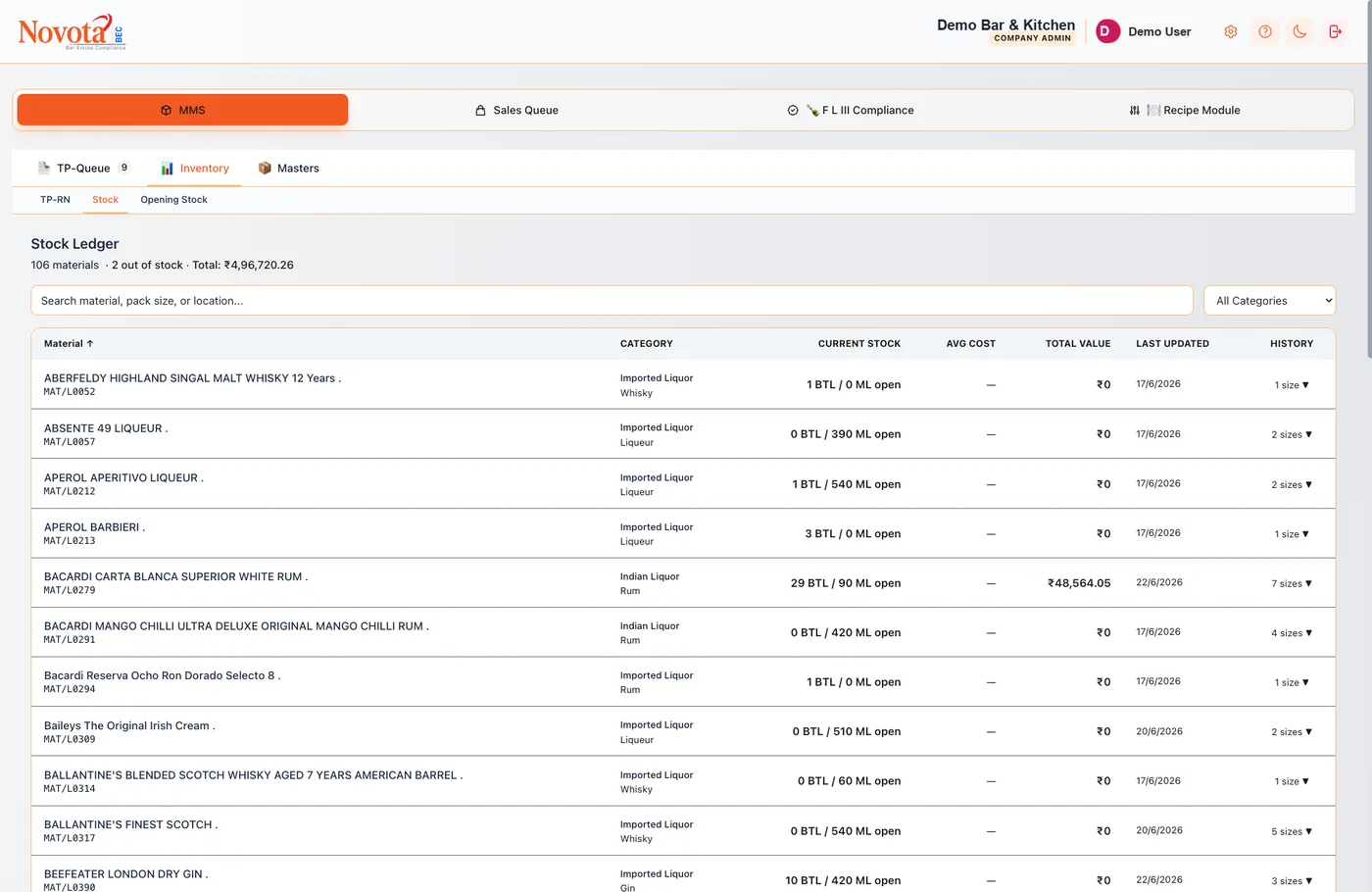 Stock kept in two buckets: whole sealed bottles, and millilitres left in open ones.
How the SCM portal counts a sale
For the daily SCM upload, each drink is counted in its own unit:
| Drink | Counted as |
|---|---|
| Spirits | Pegs of 30 ml |
| Wine | Glasses of 150 ml (125 ml if your bar pours that) |
| Bottled beer | Whole bottles |
| Draught beer | Litres, reported as a fraction of the keg |
Draught beer: reporting part of a keg
A keg is registered as one bottle, whatever its size. So a day's draught sales are reported as a fraction of a keg: one litre from a 20 litre keg is 1 ÷ 20 = 0.05. A 50 litre keg makes each litre 0.02; a 10 litre keg, 0.10.
Draught is counted in whole litres, and a part-litre carries forward. Pour 990 ml on Monday and 990 ml on Tuesday, and Monday reports nothing while Tuesday reports one litre. A blank draught row on a quiet day is expected, not a missed sale.
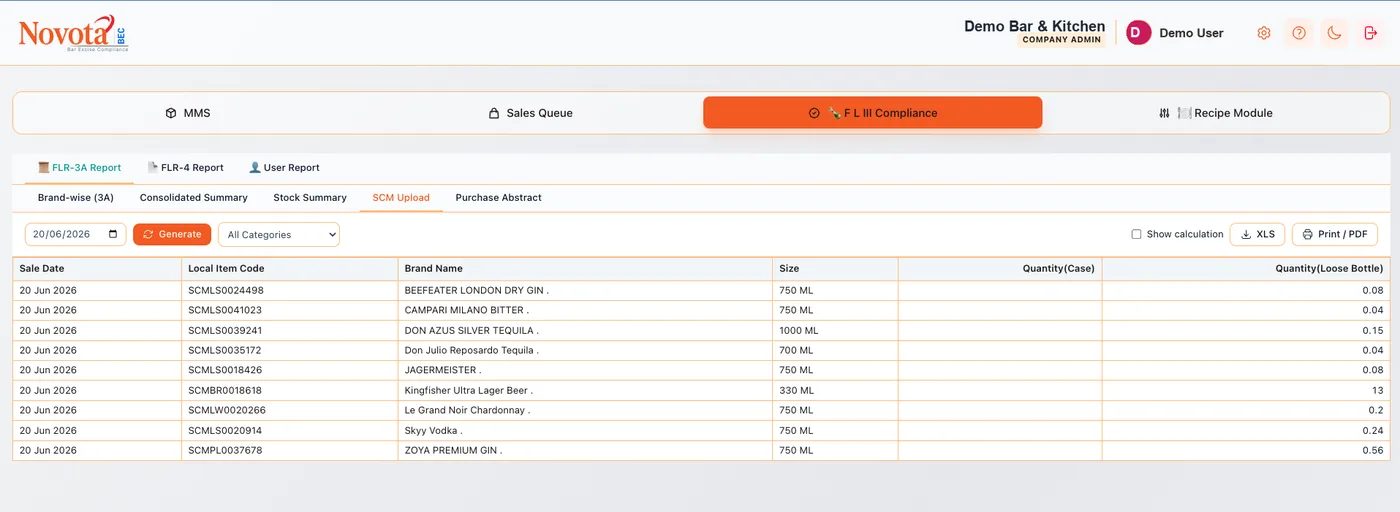 A day's sales in the local item-code format the SCM portal expects, with fractional bottles worked out per drink.
FLR-3A and FLR-4, explained
FLR-3A: the brand-wise account
FLR-3A lists every brand with its opening balance, receipts (and the TP numbers they came on), sales and closing balance, split into pack-size columns. It is the register an inspector reads line by line, so the TP number on each receipt matters as much as the quantity.
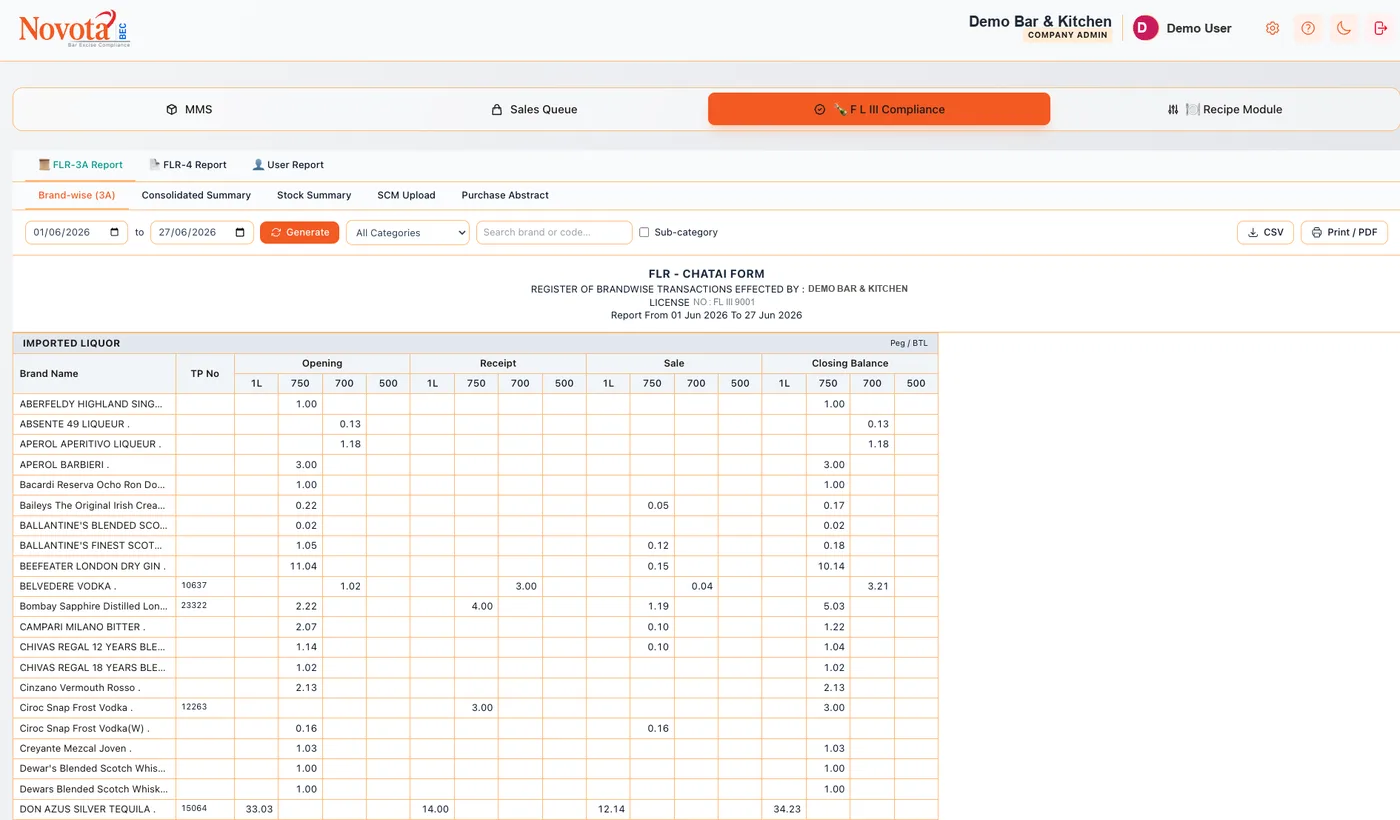 The brand-wise FLR-3A for a period, with TP numbers against receipts and balances by pack size.
The same period is usually also needed as a consolidated summary, rolled up into categories such as imported liquor, Indian beers and Indian wines, with all the period's TP numbers listed underneath.
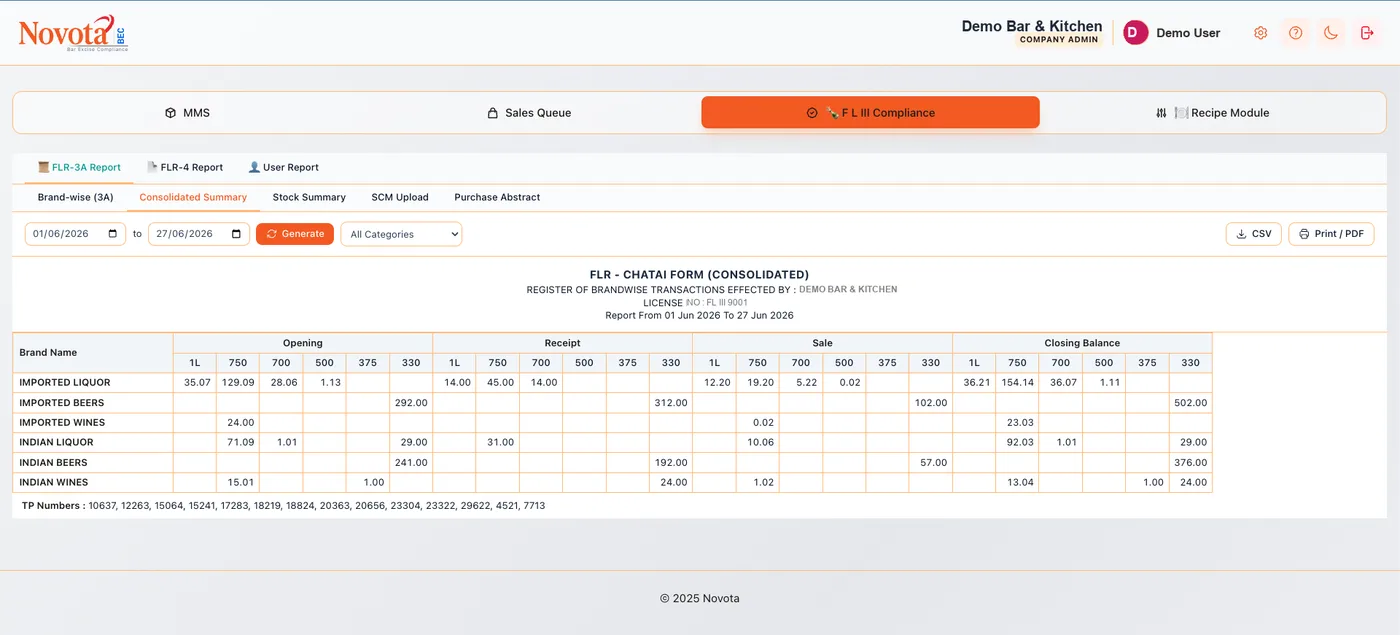 The consolidated view: categories instead of brands, same opening-to-closing logic.
FLR-4: the monthly class-totals return
FLR-4 is the monthly return under Rule 15(ii). Instead of brands, it groups stock into excise classes, each split by pack size and by imported or Indian-made:
| Class | Roughly covers |
|---|---|
| Spirits | Whisky, rum, gin, vodka, brandy |
| 50 U.P. Wines | Table, sparkling and fortified wines |
| Fermented | Strong beer |
| Mild Liquors | Mild beer |
For each column it shows the opening balance, what was received during the month, the total, what was sold to permit holders, and the closing balance. The class a brand falls in follows its category and, for beer, its excise item type — not the strength printed on the label.
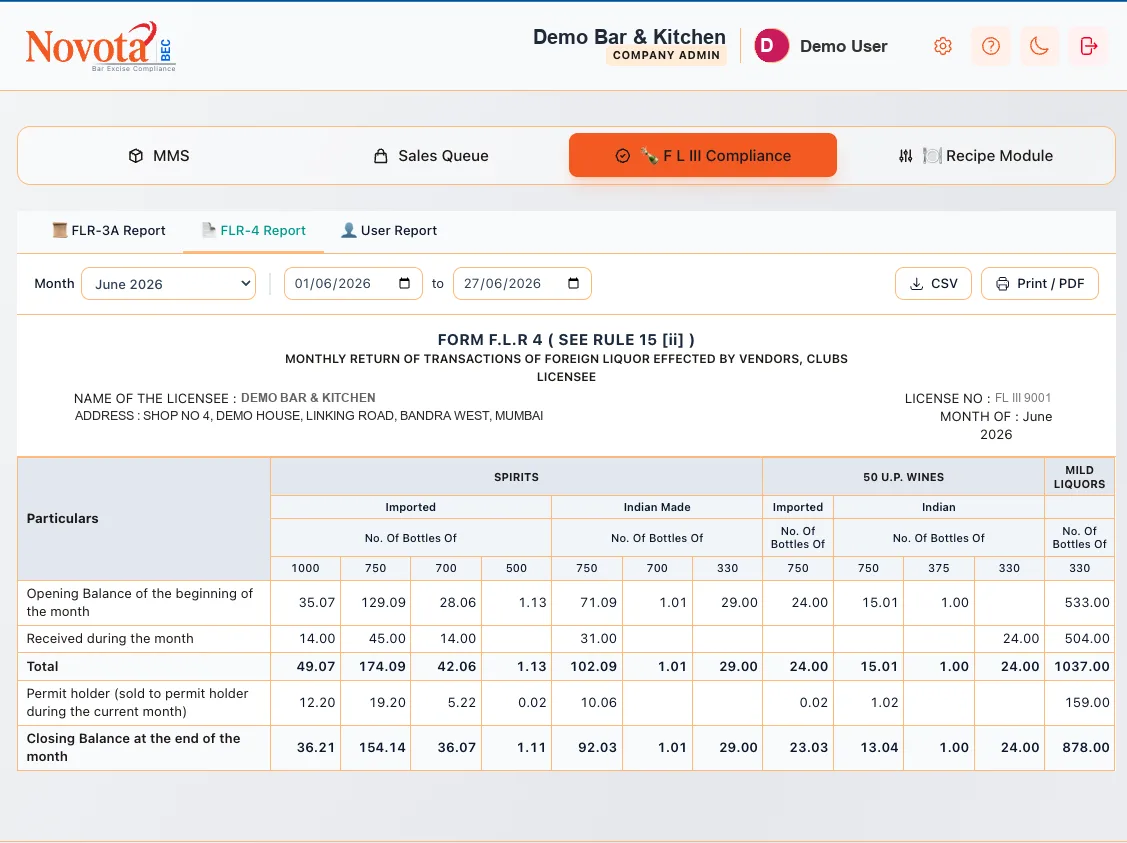 FLR-4 for a month: classes as columns, opening-to-closing rows, ready to print. Classes with no stock that month are left out.
If FLR-3A is right, FLR-4 is just a different way of adding it up. That is the point: fix the daily account and the monthly return follows.
How Novota BEC keeps the registers straight
Novota BEC (Bar Excise Compliance) was built for Maharashtra liquor licensees, together with Y²K Cost Consultancy, a Mumbai F&B cost consultancy with more than 24 years of work alongside bars, pubs, wine shops and hotels across the state. Y²K brought the excise knowledge; Novota built the software.
It runs the month in four steps.
1. Capture transport passes as stock arrives
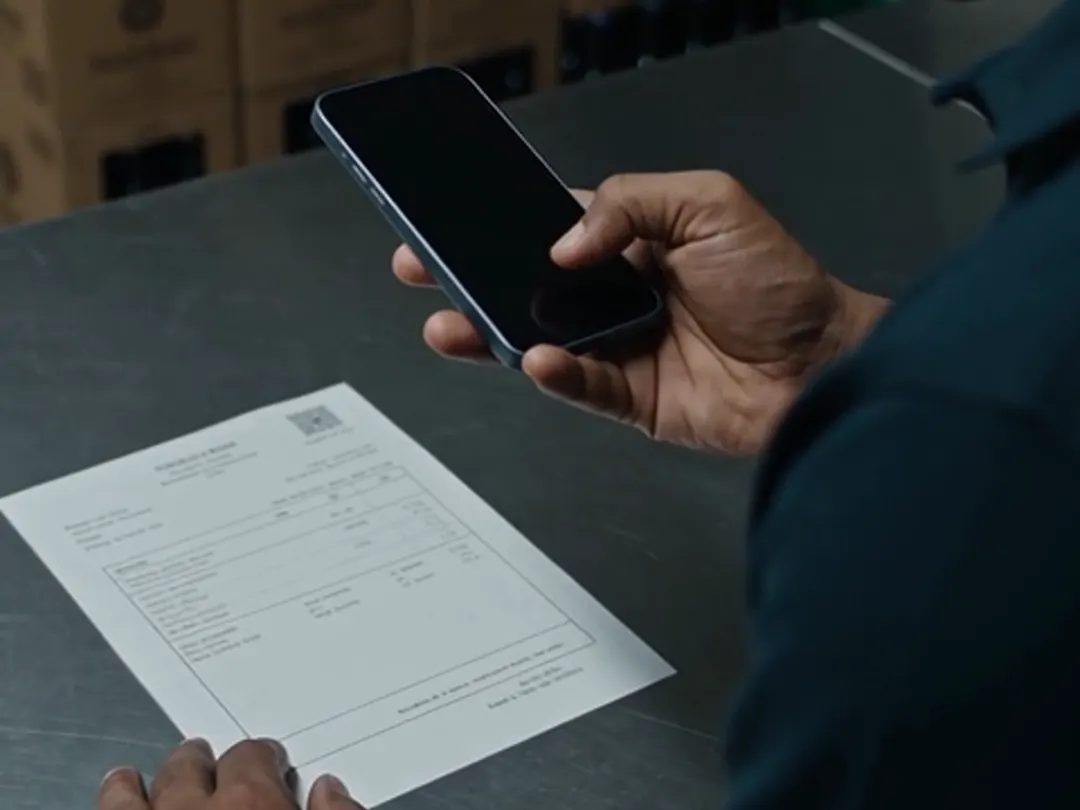 Photograph the pass when the cases arrive, not at month end.
Drop or photograph each transport pass — straight from WhatsApp is fine — and BEC reads it: pass number, date, validity, permit reference, consignee and supplier licences, and every brand with its strength, size, cases, loose bottles and batch. The receipt is dated to the pass date, exactly as excise expects, so reports stop drifting on data-entry dates.
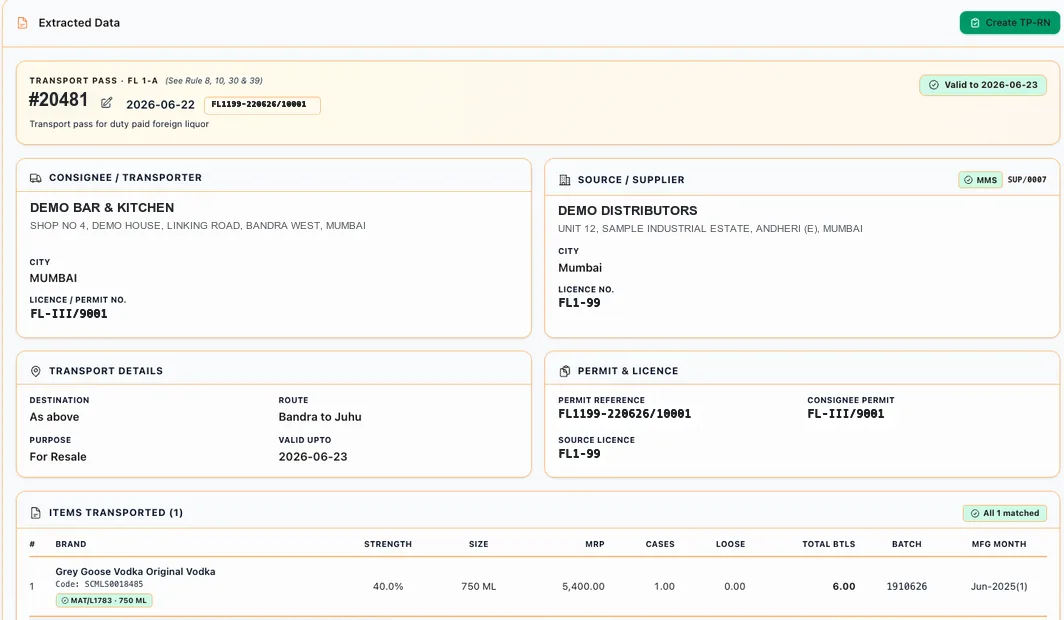 A transport pass read automatically, with each brand already matched to the Excise Master.
2. Match every brand to your Excise Master
Each brand and pack size on a pass is matched to your licensed Excise Master. Licensed, on-hand stock always wins over a catalogue-only entry, so every pass lands on one item with one excise code, however the supplier spells the brand. On the sales side, your recipes link each POS menu item to that same item.
3. Turn POS sales into stock consumption
Import the day's sales report from Posist, Petpooja, iDine or Rista, or another POS. Your drink recipes decide what each sale takes from stock: a sealed-bottle sale deducts a closed bottle, a peg or pour deducts open millilitres, and complimentary pours deplete stock at zero revenue. Days with a missing recipe or not enough stock are flagged, not silently skipped.
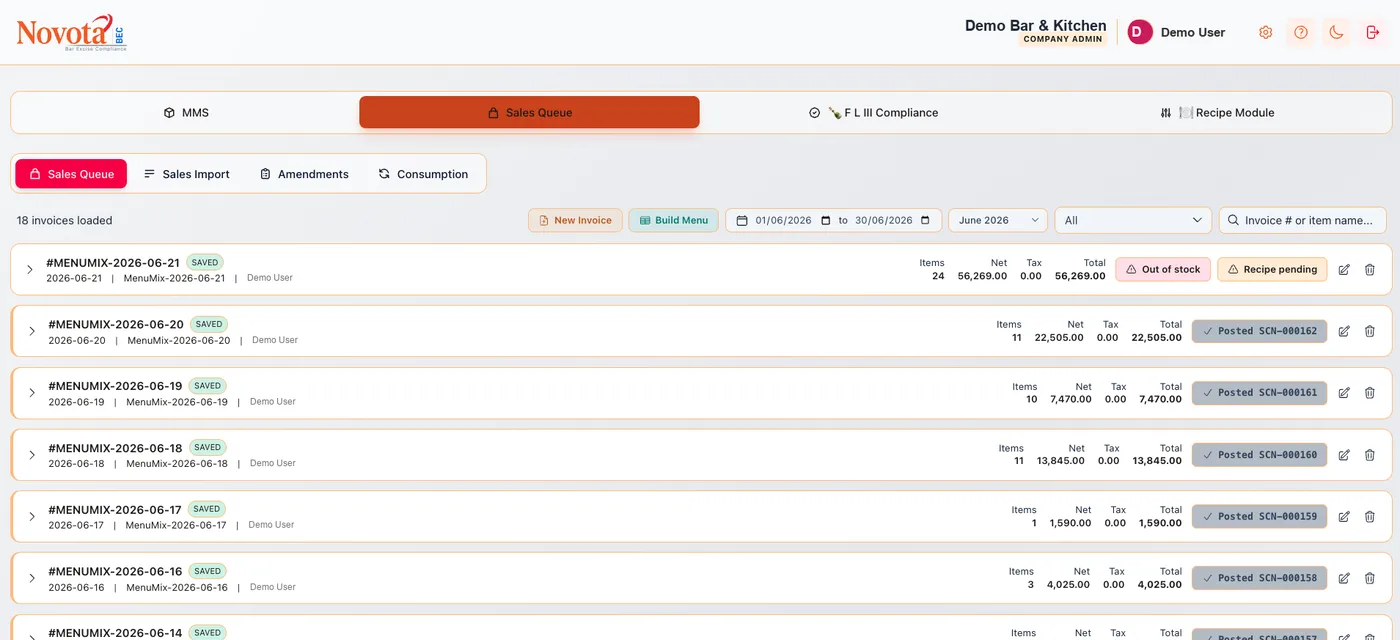 Each day's sales, posted to stock, with problems flagged before they reach the register.
4. Generate FLR-3A and FLR-4 from live data
The registers are built from the reconciled stock, not typed:
- FLR-3A brand-wise, consolidated summary and stock summary
- FLR-4 by class and pack size
- SCM Upload for each sale date, exported to XLS for the portal
- Purchase Abstract for a date, pivoting TP numbers against category and size
Pack-size columns come from the sizes actually in your data, so a bar that only stocks 750 and 330 doesn't print empty columns for every other size. Every report exports to CSV or Excel or prints to PDF. You can even import an FLR-3A your consultant prepared and compare it against what BEC computed, to catch a missed receipt or a pass number that didn't carry through.
Reconciled before you file
Behind the reports, BEC matches three sources side by side:
- What came in — every receipt, with its pass number and pack sizes.
- What the recipes used — in bottles or millilitres.
- What the POS sold — plus complimentary pours.
Opening stock plus receipts, minus consumption, has to agree across all three. When it doesn't, the cause is almost always upstream: an unmatched sale or receipt line, a missing pass number, a recipe in the wrong unit, or comps not counted. Fix it at the source and every report recalculates.
What BEC doesn't do. It supports Maharashtra excise only. It prepares your registers and returns but doesn't file them: your consultant still reviews and files, and the SCM upload is a file you submit on the portal.
Pricing
A 7-day free trial, then one flat Professional plan: ₹1,000 a month or ₹10,000 a year. Everything is unlimited: no per-pass, per-document or storage charges.
Getting started
Before you begin, keep these handy:
- Your FL-III licence number and the licensee name and address as they appear on returns
- Your Excise Master, or the brands and pack sizes you are licensed for
- Opening stock: sealed bottles and open millilitres for each brand and size
- The last month's transport passes
- A sales or menu-mix report from your POS
- Your drink recipes: which items are sold by the bottle, by the peg, by the glass or on draught
Start the trial, load opening stock, and put one week of passes and sales through. Compare the FLR-3A it produces with your hand-written register. That comparison usually tells you more about your stock than the last three inspections did.
Frequently asked questions
What is the difference between FLR-3A and FLR-4?
FLR-3A is the brand-wise account of foreign liquor: opening stock, receipts with their transport pass numbers, sales and closing balance for each brand and pack size. FLR-4 is the monthly return under Rule 15(ii) that rolls the same stock up into excise classes (Spirits, 50 U.P. Wines, Fermented and Mild Liquors) by pack size.
How are pegs and open bottles counted in excise registers?
A sale by the peg opens a bottle and reduces it by volume, so stock has to be tracked in two parts: sealed (closed) bottles and the millilitres left in open bottles. Registers then show fractions of a bottle. For the SCM portal one peg is 30 ml, so three 60 ml pegs from a 750 ml bottle are 180 ml, or 0.24 of a bottle.
How is draught beer reported to the excise portal?
A keg is registered as one bottle whatever its size, so a day's pours are reported as a fraction of the keg. One litre from a 20 litre keg is 0.05 of a bottle. Part-litres carry forward and are reported on the day the litre completes.
Is Novota BEC only for Maharashtra?
Yes. BEC is built around Maharashtra excise: FL-I-A transport passes, the FLR forms under the Bombay Foreign Liquor Rules and the licensed Excise Master. Other states are not supported today.
Does Novota BEC replace my excise consultant?
No. BEC keeps your registers and returns accurate and ready, but your consultant still reviews and files them.
Which POS systems can BEC read sales from?
BEC reads menu-mix and sales reports from Posist, Petpooja, iDine and Rista, and can import other POS reports too. The sales are translated into stock consumption through your drink recipes.