Bar Stock Variance: How to Count Every ml and Find Where the Liquor Goes
· 9 min read
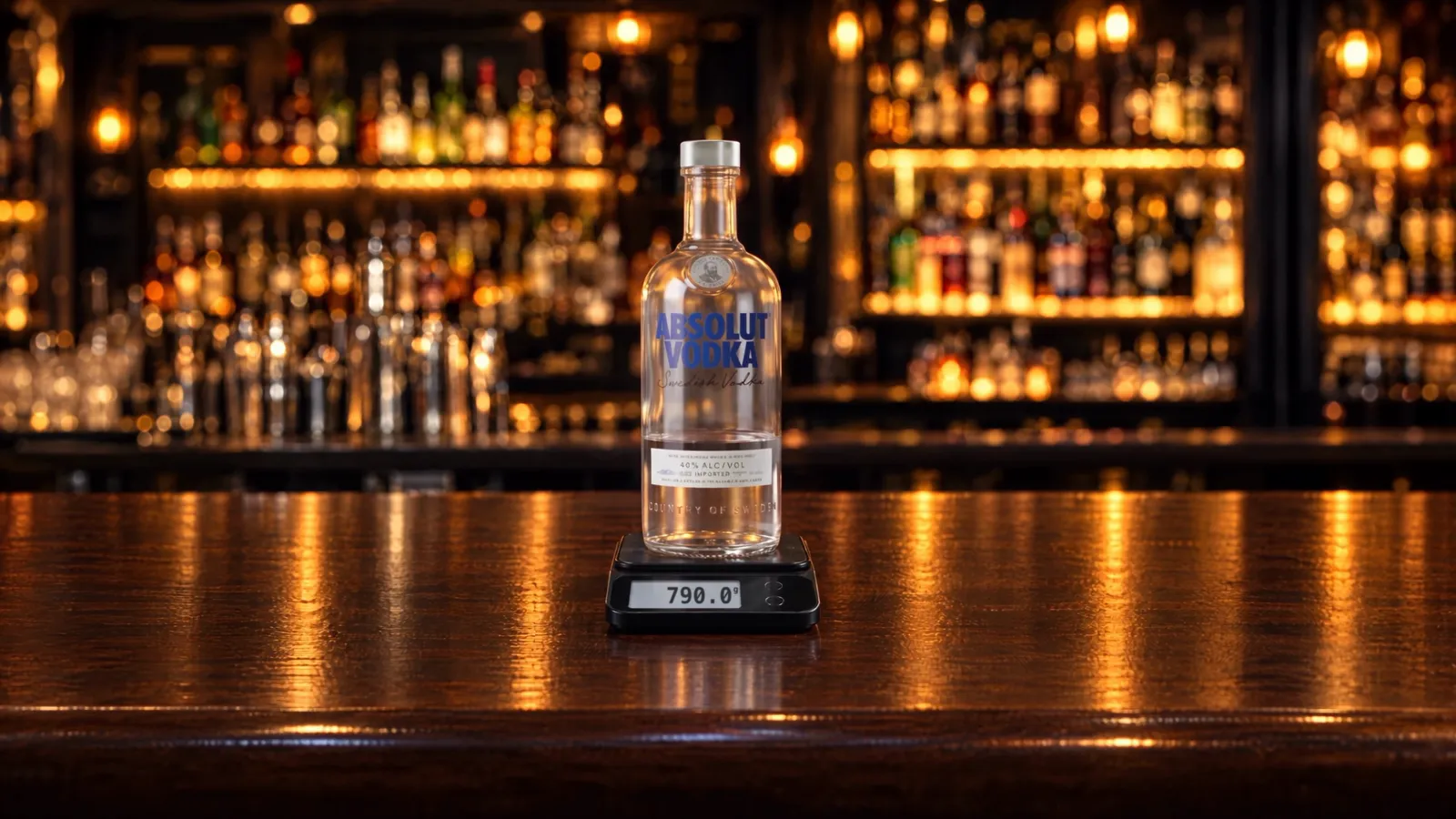
Ask a bartender how much is left in an open bottle of vodka and you will get a confident answer: "about five pegs." Weigh it, and there are seven. Or three. Eyeballing an open bottle is wrong in both directions, and across 100 brands and three stores, the errors stop cancelling out.
That gap between the book and the shelf is where a bar's margin quietly leaks: an extra splash in every pour, a drink that was never billed, a bottle that left the store and never reached the bar. You can't fix what you can't measure, and most bars can't measure it more precisely than "roughly a bottle short."
This guide is for bar owners, beverage managers and auditors. It explains what bar stock variance is, how to calculate the system count, how to count open bottles accurately, and how to read a variance report so it leads to action.
One bottle, two numbers
Every brand on your shelf has two numbers:
- What the book says you should have, from opening stock, purchases and sales.
- What is on the shelf when you count it.
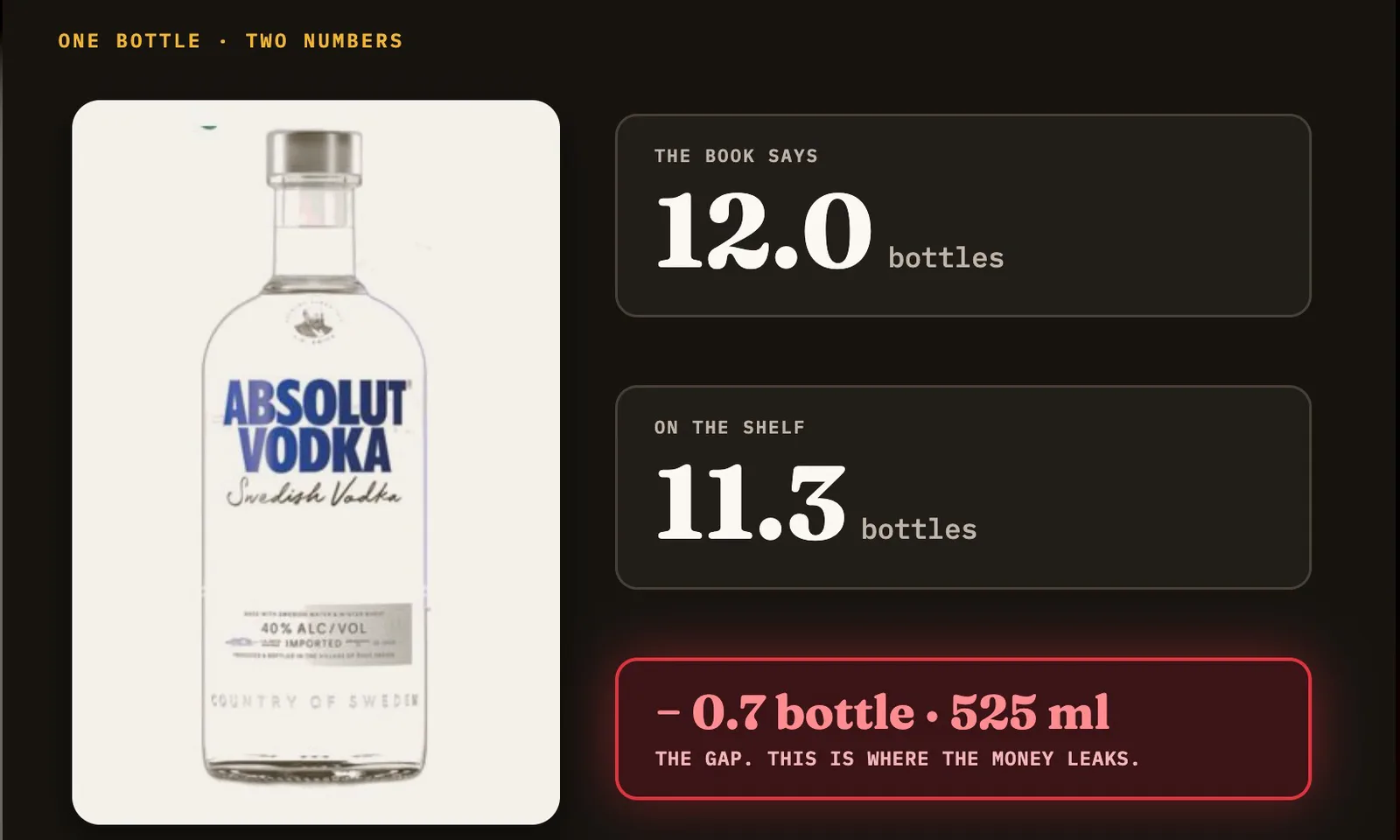 Book 12.0, shelf 11.3. The 0.7-bottle gap is where the money leaks.
In this example the gap is 0.7 of a 750 ml bottle: 525 ml, or 17½ pegs. At an MRP of ₹1,600 a bottle, that's roughly ₹1,120 for one brand in one counting period. Multiply that by every brand behind the bar.
Where the liquor goes
Variance has a short list of usual causes:
- Over-pouring. A 30 ml peg poured free-hand is often 35 or 40 ml.
- Unbilled drinks. Comps, staff drinks and "on the house" pours that never reach the POS.
- Spillage and breakage that nobody writes down.
- Wrong recipes. A cocktail mapped to 45 ml when the bar pours 60.
- Transfers not recorded. Bottles that leave the bond store and never arrive in the bar's books.
- Counting errors. Eyeballed open bottles, and sealed bottles counted twice or missed.
- Theft. Less common than owners fear, but it hides behind all of the above.
The point of a variance report is to separate these. A steady small shortfall across every spirit suggests pour size. A large shortfall on one premium brand suggests something else.
How to calculate the system count
The book side of the variance, the system count, is simple arithmetic, done in ml:
System count = opening stock + purchases − sales (by recipe)
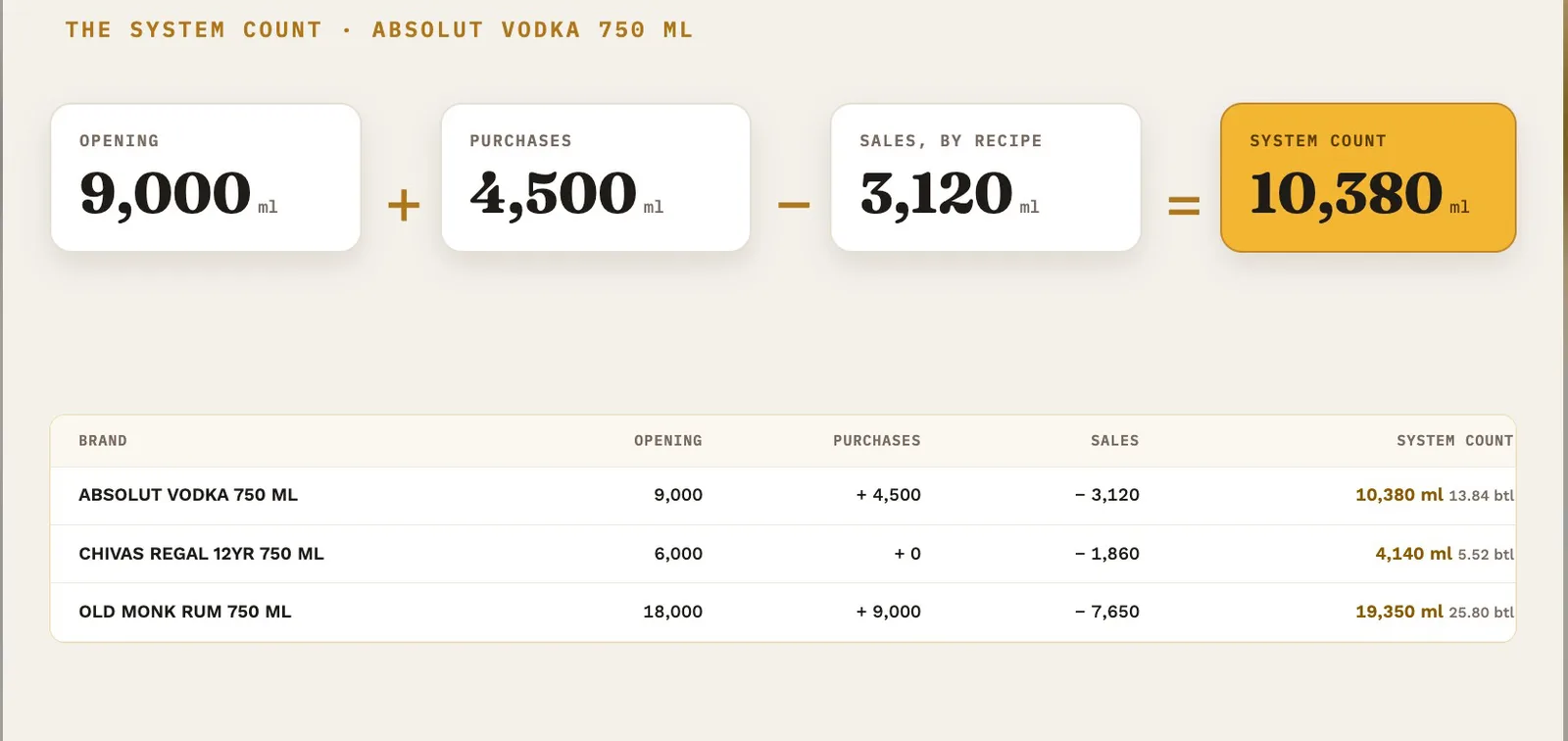 Opening + purchases − sales by recipe = what you should have.
For Absolut Vodka 750 ml: 9,000 ml opening + 4,500 ml purchased − 3,120 ml sold = 10,380 ml, or 13.84 bottles. If the count finds less than that, the difference is your variance.
Two details make or break this number.
Sales must be converted through recipes. The POS says "Whisky Sour × 12". Stock needs to know that each one is 60 ml of whisky, plus lemon juice and sugar syrup. Without recipes in ml, the book side of a cocktail bar is guesswork.
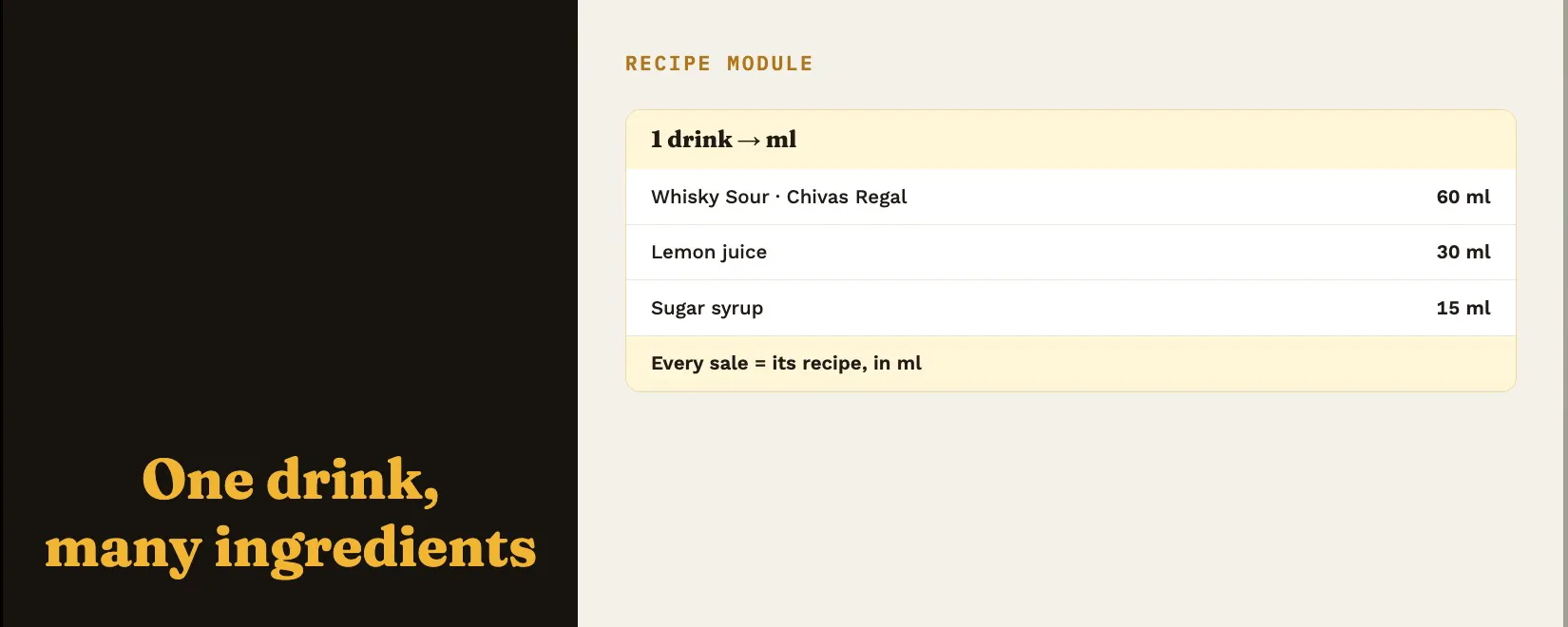 One drink, many ingredients. Every sale becomes its recipe, in ml.
Every store must be counted in its own place. Most bars have more than one: a bond store holding sealed stock as received, sometimes a bar store, and the bar itself where bottles are open. Stock moving between them has to be recorded as a transfer, or one store looks short and the other looks long.
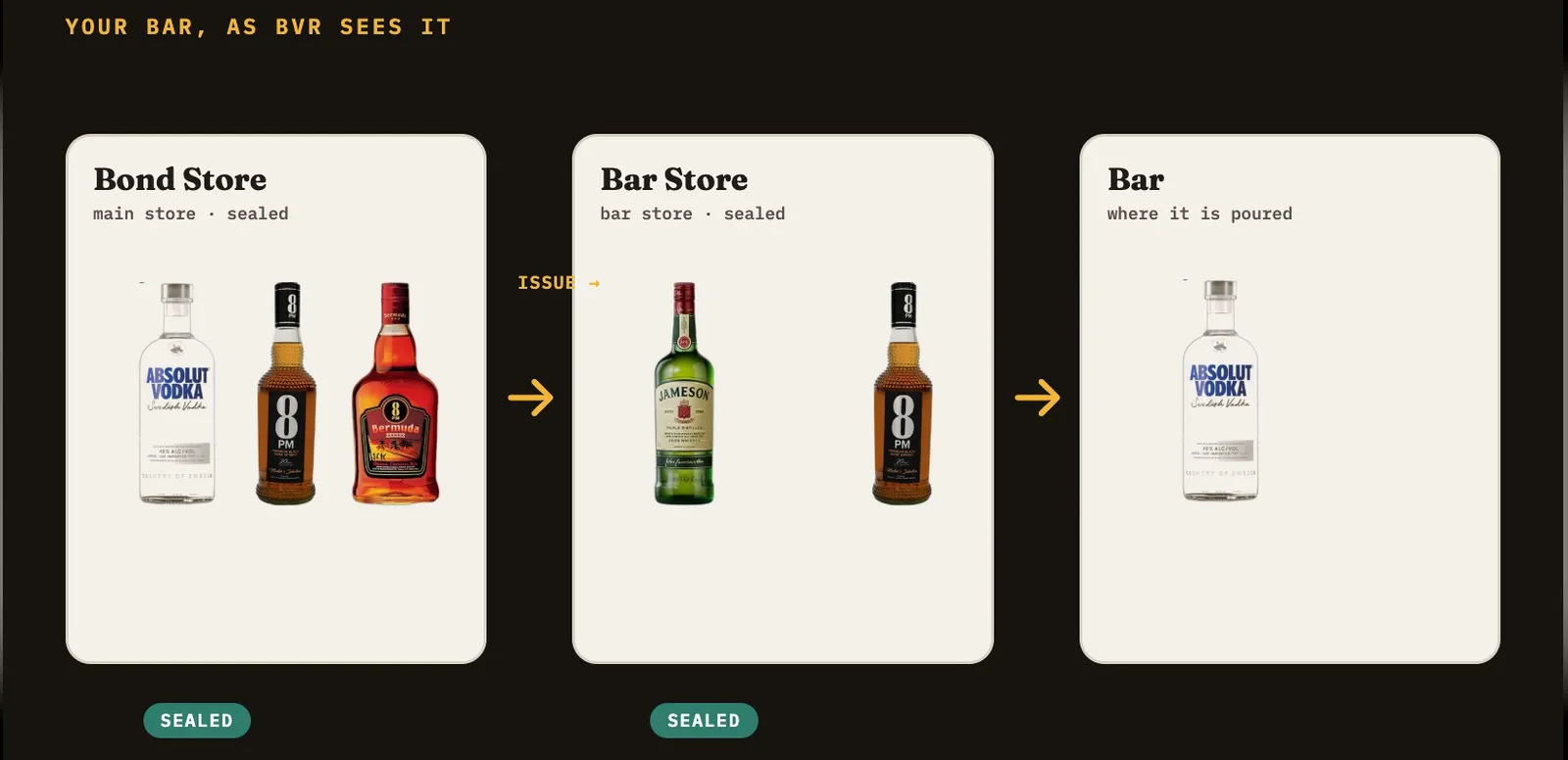 Bond store, bar store and bar, each counted in its own place. Sealed bottles and open ml stay apart.
Three ways to count an open bottle
Sealed bottles are easy: count them. Open bottles are where accuracy is won or lost.
1. Weigh it
A scale is the most accurate way. The liquid in a bottle is its weight on the scale, minus the empty bottle's weight, divided by the spirit's density.
For example, if an empty bottle weighs 594 g and the spirit's density is 0.95 g/ml, a reading of 790 g means (790 − 594) ÷ 0.95 ≈ 206 ml, or about seven pegs. Do that for every brand and size, and every open bottle gets a precise figure in seconds.
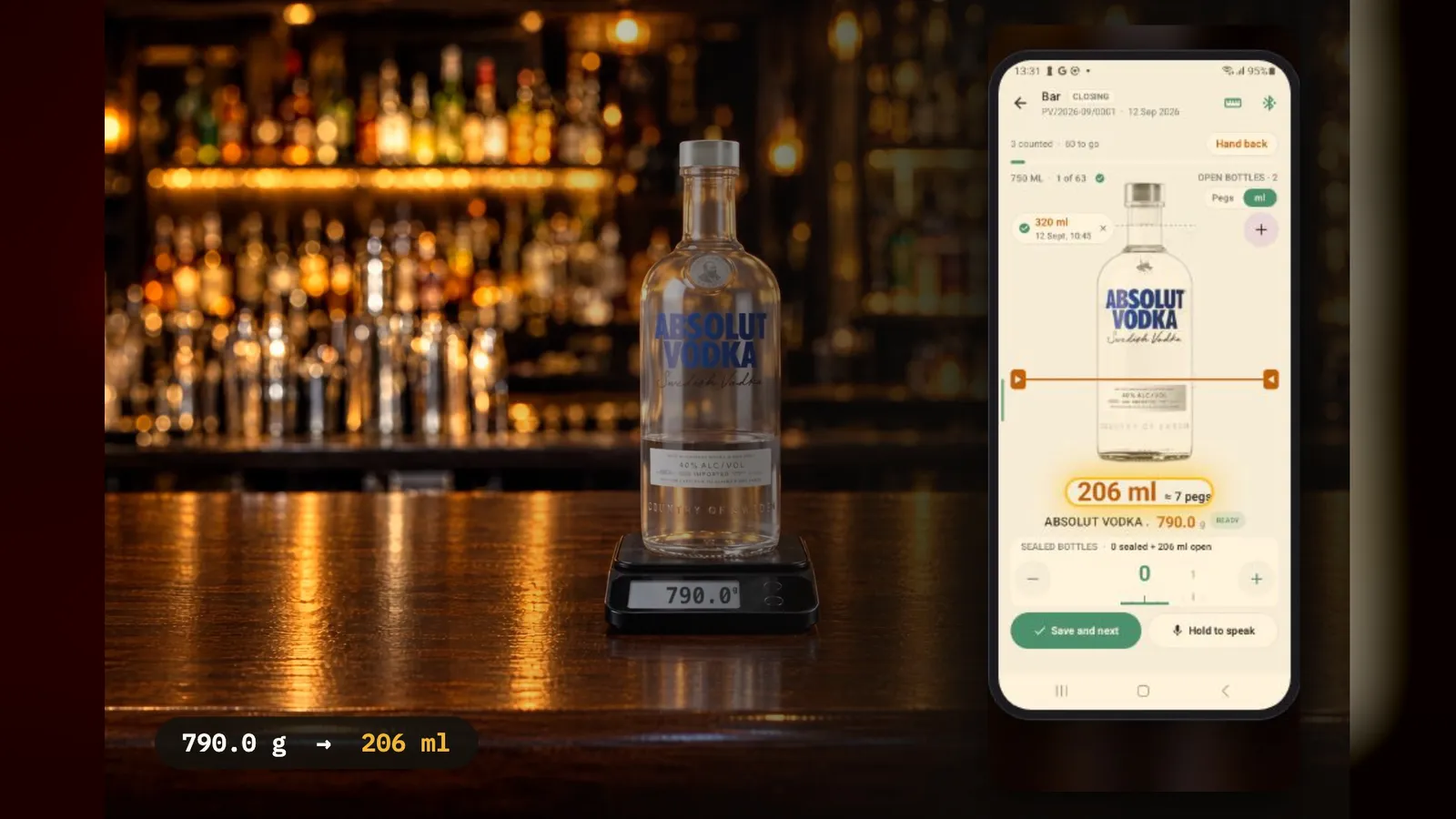 790.0 g on the scale becomes 206 ml on the phone.
2. Mark the level on the real bottle shape
No scale? Mark where the liquid is. But a bottle isn't a cylinder. It has shoulders, a neck and often a thick base, so a line halfway up is not half full. A level count is only accurate if it follows the actual shape of that bottle.
3. Say it
For a fast closing count, speaking is quicker than typing: "Absolut, two bottles, two hundred and six ml." The count is read back before it is saved, so a misheard number gets caught.
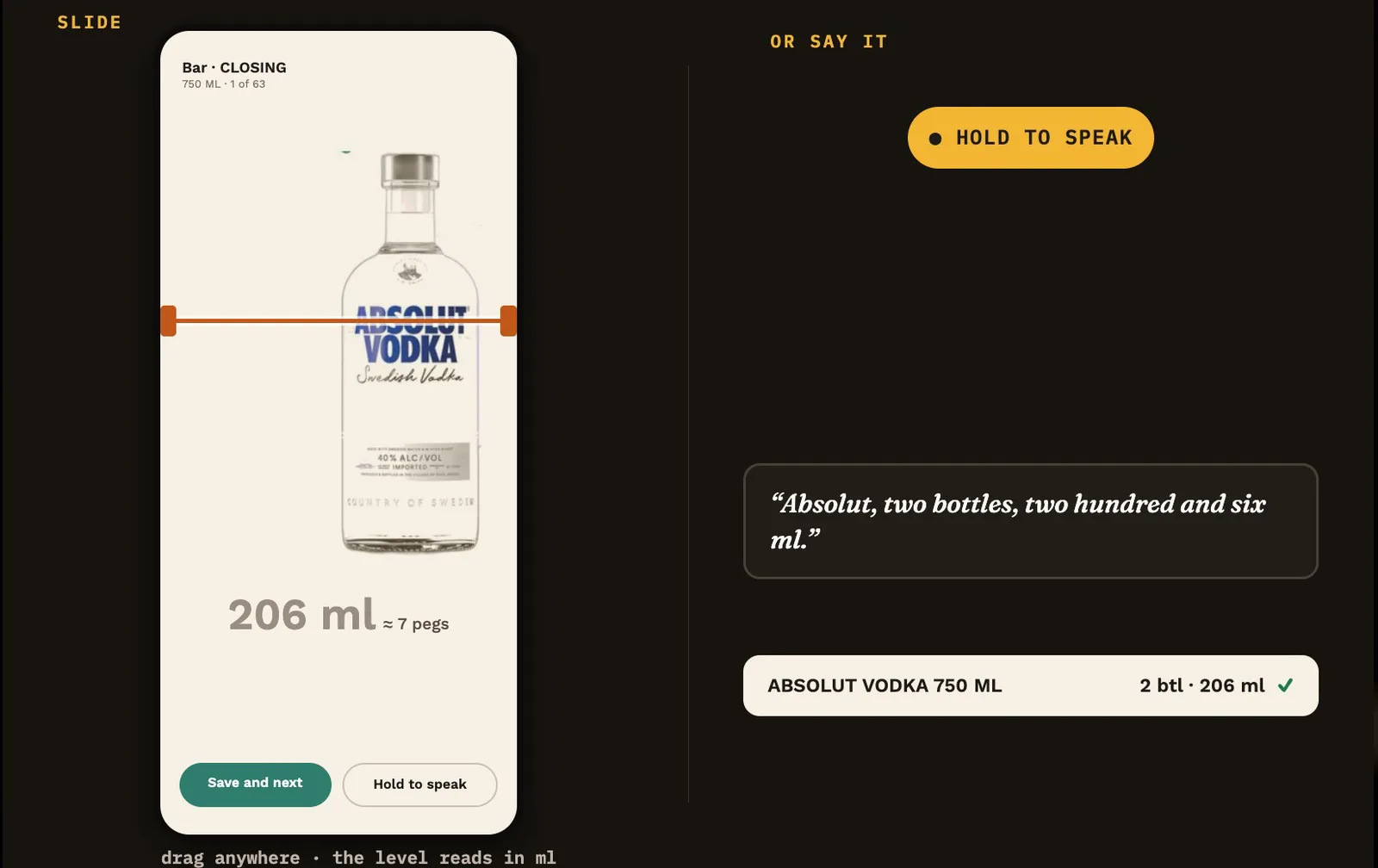 Slide the line to the liquid level, or say the count out loud.
Reading a variance report
A good variance report puts expected and physical stock side by side for every brand, in both sealed bottles and open ml, then shows the difference in ml and in rupees:
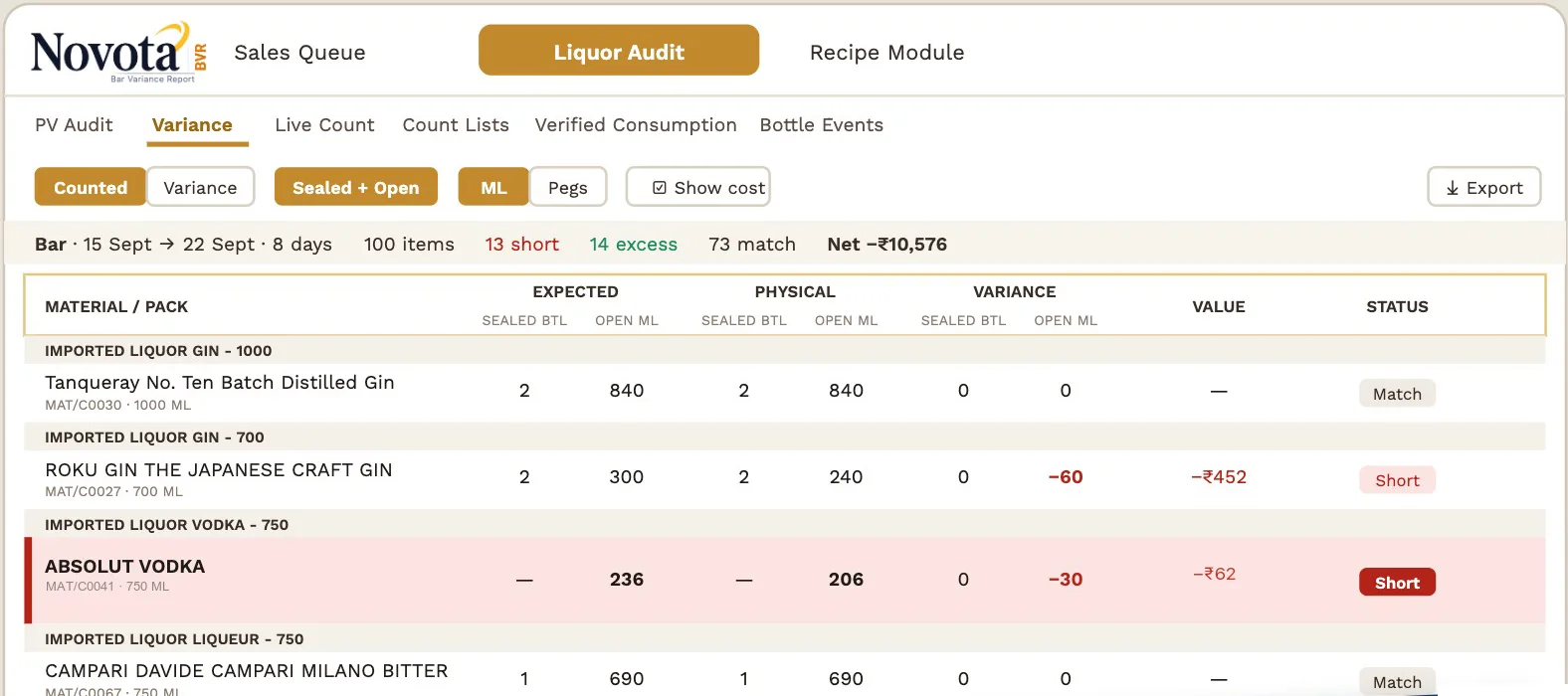 100 items over 8 days: 13 short, 14 excess, 73 match. Example data, not a real bar.
How to read it:
- Start with the net figure, then sort by value. A ₹452 shortfall on a premium gin deserves more attention than 30 ml of a well vodka.
- Look at excess as well as short. An excess usually means a sale was recorded against the wrong brand, a recipe is overstated, or a purchase was entered twice. Shorts and excesses on similar brands often cancel out.
- Look for patterns over several counts. One short week is noise. The same brand short every week is a cause.
- Count at the same point every time, such as closing, so open bottles are compared like with like.
How Novota BVR does it
Novota BVR (Bar Variance Report) does all of the above for you: every ml accounted for, physical stock in bottles and ml, reconciled against your books.
It runs in four steps:
- Enter the opening balance: where every brand stood at the start.
- Drop in the sales from your POS. BVR imports from Posist, Pet Pooja, Rista, Dyne CC and WINCloud.
- Drop in the purchases: photograph a transport pass or a liquor invoice on your phone and BVR reads it into the queue for you to check.
- Take the physical count: weigh it, slide it, say it or key it in.
The system count is worked out for you, in ml, from opening + purchases − sales by recipe.
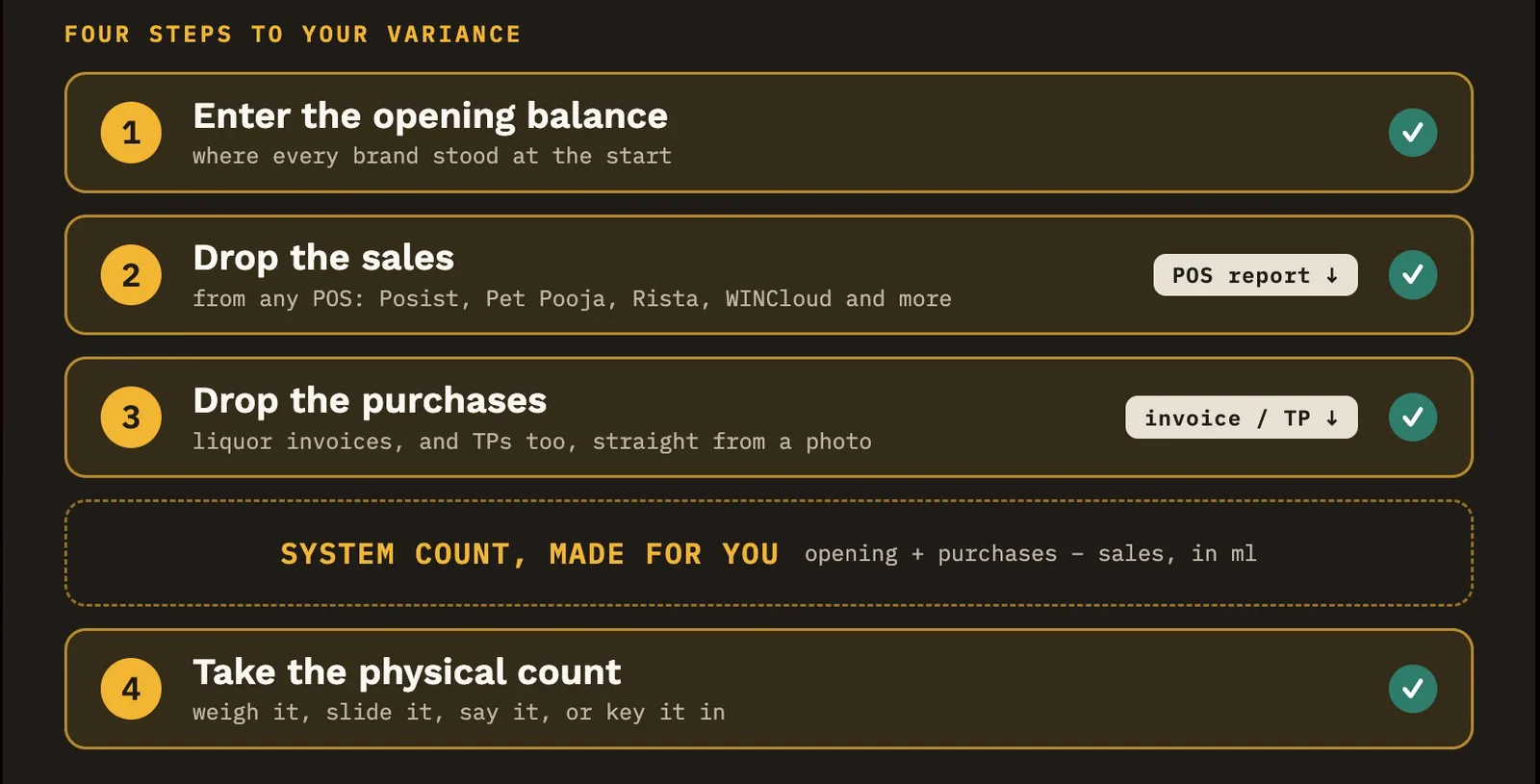 Four steps to your variance. The system count is made for you.
Counting, the way the bar actually works
- Scale: place the bottle on a Hoffen scale. It sends the grams over Bluetooth, and BVR turns them into ml using that bottle's empty weight and density.
- Slide: drag a line to the liquid level on the real bottle shape. BVR knows that halfway up is not half full.
- Voice: hold the space bar on a laptop, or the button in the Android app, and say the brand, the number and the unit — in English, Hindi or Marathi. "Teen sau sattar", "तीनशे सत्तर" and "three seventy" are all 370 ml. BVR reads it back, and nothing saves until you confirm.
Counts show in ml or pegs, at 30 ml a peg.
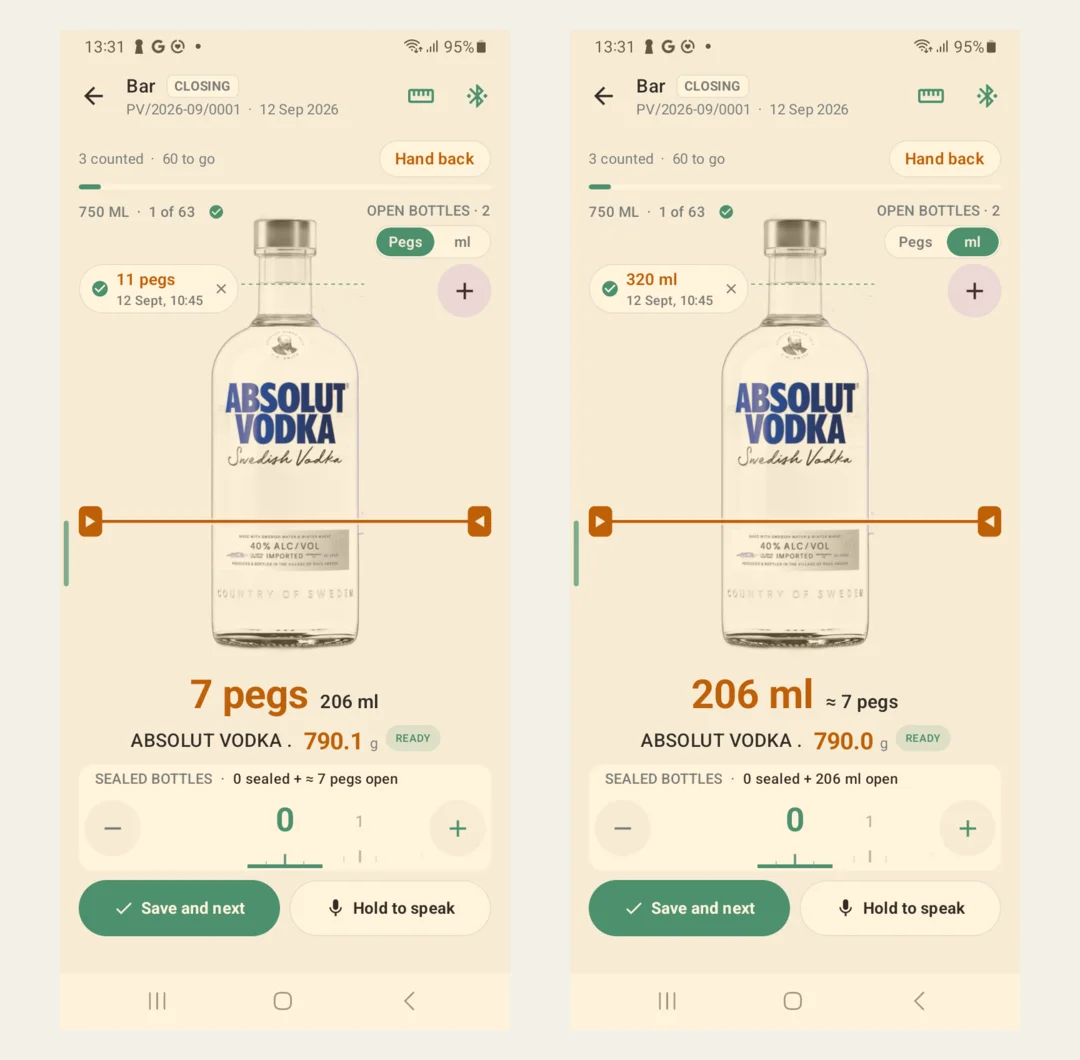 The same open bottle in pegs and in ml, read from the scale.
One count, every screen
The Android app counts with you. Scan a code to join a count that is open on the web, and everyone sees the table update live while one device drives at a time. If the signal drops in the store room, the app keeps the counts on the phone and sends them when the connection comes back.
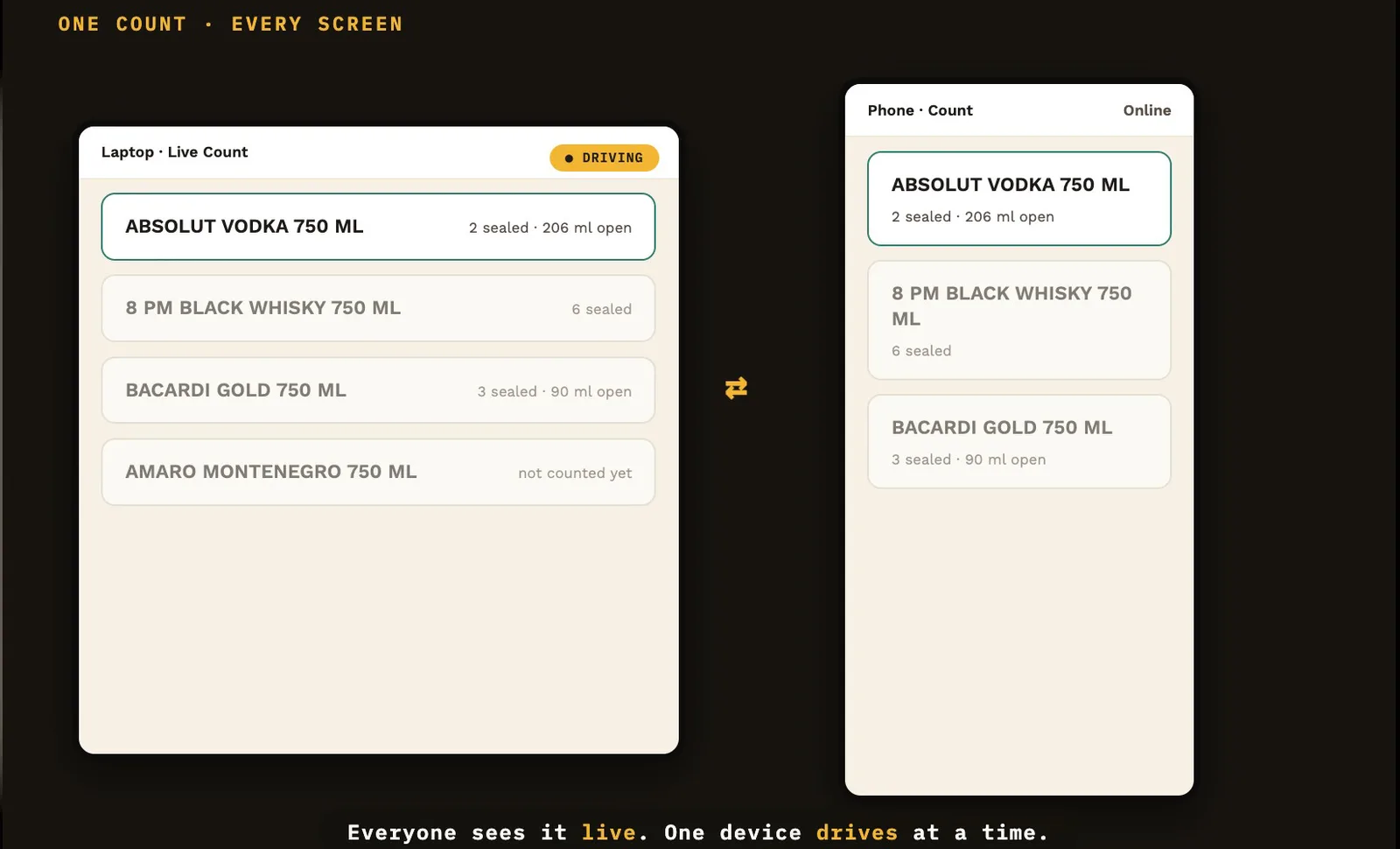 Everyone sees it live. One device drives at a time.
Set up the way your branch runs
Stores and departments are set up per branch: bond only, bar only, or a bond store, bar store and bar together. An inter-branch transfer moves sealed bottles, and both sides post at once.
Short, excess or match
The result is a sheet with opening, purchase, sale, transfer and closing reconciled brand by brand, and the gap in ml and in rupees at MRP. Print it, sign it, file it: one sheet per count.
For excise registers (FLR-3A, FLR-4 and the SCM upload), see Novota BEC. BVR is about what's physically on your shelf; BEC is about what you report to excise.
Getting started
BVR is set up with you, not left to a wizard. Before the first count, the Novota team sets up your branches, stores and brand list with you. Keep these ready:
- Your stores: bond store, bar store, bar, and any other outlets
- Your brand list with pack sizes
- Opening stock, with sealed bottles and open ml
- A recent POS sales report and your drink recipes
- Recent purchase invoices and transport passes
 Every ml accounted for.
Frequently asked questions
What is bar stock variance?
It is the difference between what your books say should be on the shelf and what is physically there. The book side is opening stock plus purchases minus sales converted to ml through your recipes. The physical side is the count. A shortfall is liquor that left without being billed.
How do you count an open bottle accurately?
Weigh it, or mark its level on the real bottle shape. A scale gives grams, which become ml using the bottle's empty weight and the spirit's density. A level line works if it follows the bottle's actual shape, because a line halfway up is not half full.
How many ml is a peg?
For stock and variance purposes a peg is 30 ml, so a 750 ml bottle holds 25 pegs. A 60 ml large is two pegs.
Do I need a scale to use Novota BVR?
No. A scale is one way to count. You can also speak the count or drag a line to the liquid level on the bottle, and use whichever suits the bottle and the moment.
Which POS systems can BVR import sales from?
Posist, Pet Pooja, Rista, Dyne CC and WINCloud.
Does it work for a bond-only or bar-only licence?
Yes. Stores are set up per branch: bond store only, bar only, or a bond store, bar store and bar together. Inter-branch transfers move sealed bottles and post on both sides at once.