HR and Payroll for Indian Businesses: A Practical Guide for 2026
· 13 min read

It is the last night of the month. The restaurant has closed, and the owner is at the back-office desk with the attendance register, a stack of leave slips, a calculator and a WhatsApp thread where three people have asked for an advance. Tomorrow 30 people expect the right salary in their bank account, and the PF and ESI dues follow in two weeks.
Most small and mid-sized businesses in India still run payroll like this. It works until it doesn't: a missed half day turns into a salary dispute, an advance never gets recovered, or a PF challan is filed late and the penalty arrives.
This guide is for owners, managers and HR heads of restaurants, hotels, retail stores, clinics and small offices. It covers how the monthly cycle actually works, what the numbers mean, which statutory rules apply, and where software takes the work off your desk.
Why HR and payroll matter more than they look
Payroll is usually the biggest cost a service business controls every month, and the one employees care about most. Getting it wrong costs you in three ways:
- Money. Paying for days nobody worked, forgetting to recover an advance, or paying overtime that was never approved.
- Trust. A wrong salary once is forgiven. Wrong twice, and good people start looking elsewhere, which hurts most in hospitality where attrition is already high.
- Compliance. PF, ESI, professional tax and TDS each have their own rates, thresholds and due dates. Late deposits attract interest and damages.
The good news is that almost every payroll error starts in one place: the data that goes in. Get attendance, leave and salary structures right, and the calculation itself is the easy part.
The monthly payroll cycle, step by step
Whatever tools you use, every payroll month runs through the same eight steps:
- Employee records. One record per person: department, role, shift, bank account, PAN, UAN for PF and IP number for ESI.
- Attendance. Who came in, when, and for how long, including late marks and half days.
- Leave, week-offs and holidays. Approved leave is paid; unapproved absence is loss of pay (LOP).
- Overtime and adjustments. Approved overtime, incentives, advances to recover, fines or arrears.
- Salary calculation. Gross pay for the payable days, then statutory deductions.
- Review and approval. Someone checks the outliers before money moves.
- Payslips and payment. Salaries go out from the bank and every employee gets a payslip.
- Statutory filings and books. PF, ESI, professional tax and TDS are deposited and filed, and the salary journal is posted to your accounts.
Steps 1 to 4 are where the time goes. Steps 5 to 8 are where the mistakes show.
Attendance decides whether payroll is right
 A selfie and a location on each punch replace the register at the door.
Salary in India is paid on payable days. If a monthly gross of ₹28,200 is paid over a 30-day month, each day is worth ₹940. Two days of unrecorded absence is ₹1,880 paid for nothing. Two days of absence that were actually approved leave, but marked as LOP, is ₹1,880 cut from someone who did nothing wrong.
Paper registers and shared spreadsheets struggle with:
- Buddy punching. One person signs in for a friend who is running late.
- Missed punches. Someone forgets to sign out and the day looks incomplete.
- Field and multi-site staff. Delivery riders, sales staff and supervisors who move between outlets.
- Silent absences. Nobody marks the person who simply didn't turn up, so they are paid by default.
A good attendance system takes a selfie and a location with every punch, marks staff absent automatically when they never punch in (but skips holidays and week-offs), and lets a manager regularise a genuine missed punch in one tap, with a record of who changed what.
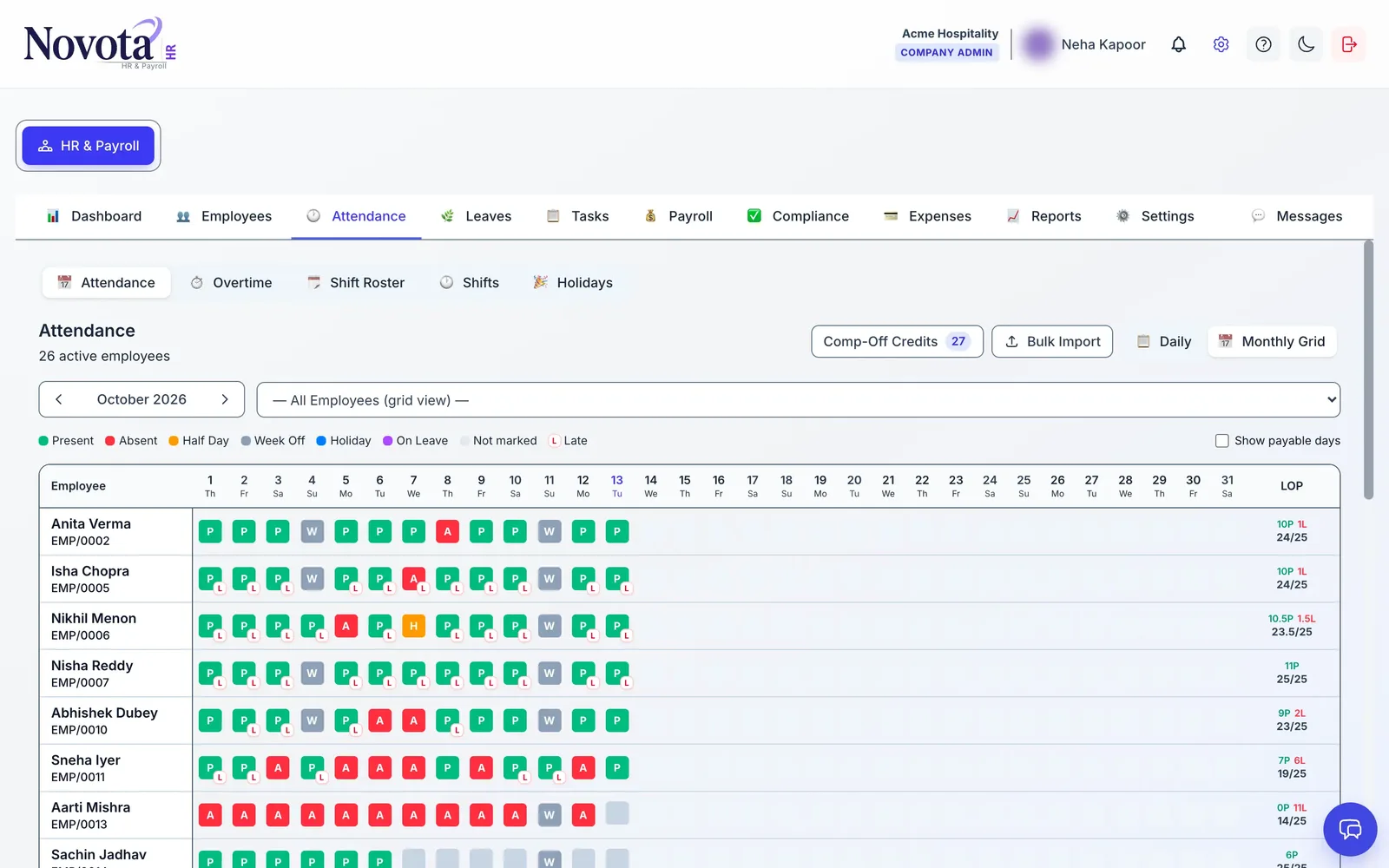 One monthly grid per team: present, absent, half day, week-off, holiday, leave and late marks, with loss-of-pay days totalled on the right.
Shift teams need a roster, not a fixed 9-to-6
Restaurants, hotels, hospitals and retail stores don't run on office hours. A cook might do a lunch shift on Monday, a split shift on Tuesday and closing on Saturday. If your attendance system only knows "10 am to 7 pm", then every late mark, overtime hour and absence it reports is wrong.
What shift-based businesses need:
- A weekly or monthly roster that managers can fill quickly: set everyone's usual shift, then paint the exceptions.
- Rule checks before publishing. Long days, too little rest between shifts, too many days in a row and no weekly day off should be flagged before the roster goes out, not after someone burns out.
- Coverage at a glance. How many cooks, waiters and dishwashers are on each shift, and where you are short.
- Attendance that follows the roster. Late marks, overtime and week-offs judged against each person's published shift.
- Swaps and open shifts that staff can request and a manager approves.
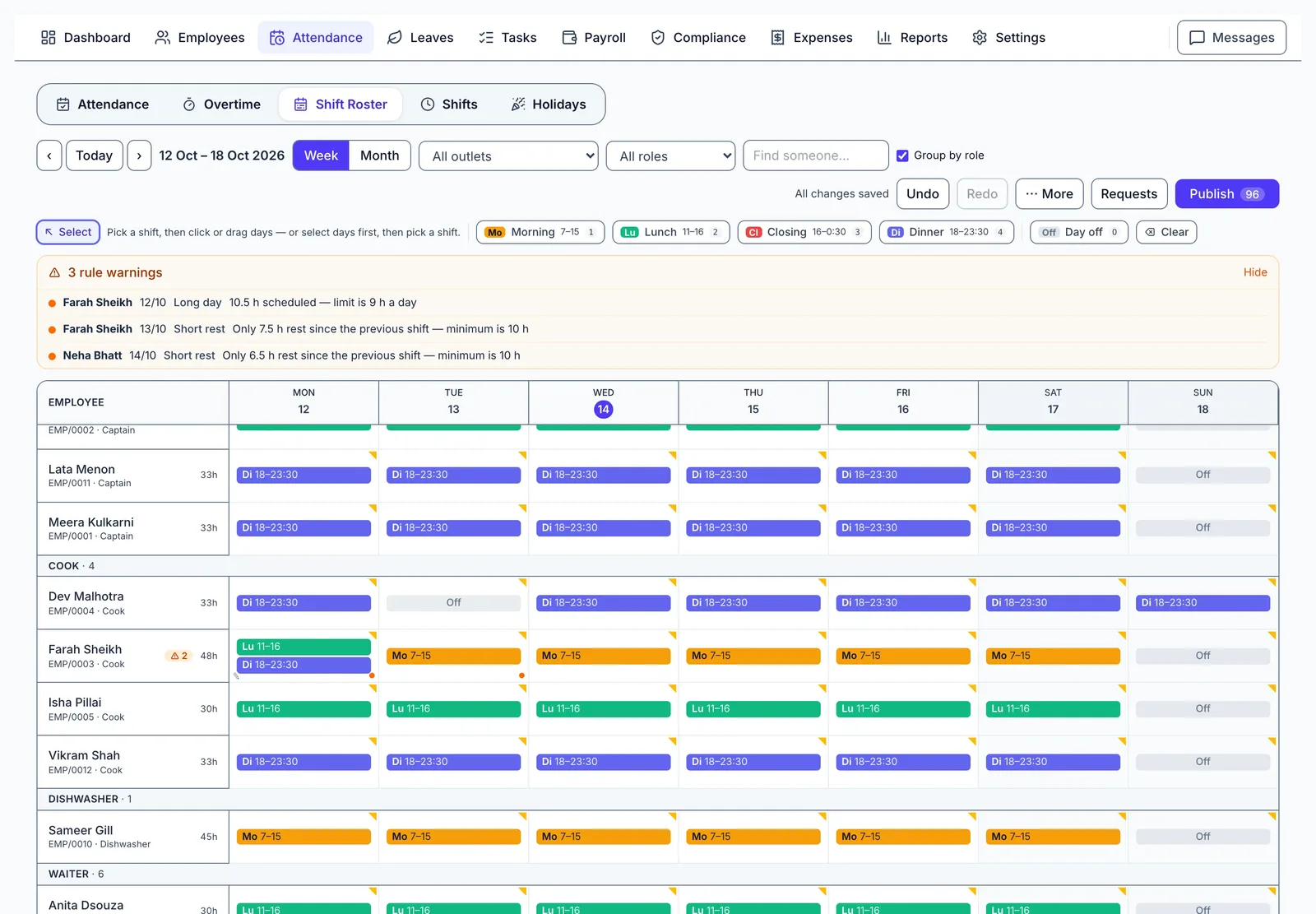 Rule warnings appear above the roster before you publish: here, a 10.5-hour day and two cases of short rest between shifts.
CTC, gross and net: the three numbers on every offer
Most salary arguments begin because the employer is talking about one number and the employee is thinking about another. Here is a typical monthly structure for a ₹3.6 lakh a year role:
| Component | Monthly | Notes |
|---|---|---|
| Basic | ₹15,000 | 50% of CTC |
| House Rent Allowance (HRA) | ₹6,000 | 40% of basic |
| Special allowance | ₹7,200 | Balancing figure |
| Gross salary | ₹28,200 | What the employee earns before deductions |
| Employer PF (12% of basic) | ₹1,800 | Paid by the employer, not shown on take-home |
| Cost to company (CTC) | ₹30,000 | ₹3,60,000 a year |
| Employee PF (12% of basic) | − ₹1,800 | |
| Professional tax (Maharashtra) | − ₹200 | ₹300 in February; varies by state |
| ESI | — | Not applicable: gross is above ₹21,000 |
| TDS | — | Nil at this income under the new tax regime |
| Net take-home | ₹26,200 | What reaches the bank account |
So the same job is "₹30,000 a month" to the owner, "₹28,200" on the payslip and "₹26,200" in the bank. Put all three on the offer letter and most of those conversations never happen.
Some employers also include gratuity, bonus or insurance in CTC. That is fine, as long as the offer letter says so.
The 50% wage rule
Since the labour codes came into force in November 2025, "wages" for PF, gratuity and similar benefits means basic pay, dearness allowance and retaining allowance. If allowances such as HRA, conveyance and special allowance together exceed half of total pay, the excess is counted as wages anyway. In practice, keep basic (plus DA) at or above 50% of the total and your statutory figures stay predictable. The structure above does exactly that.
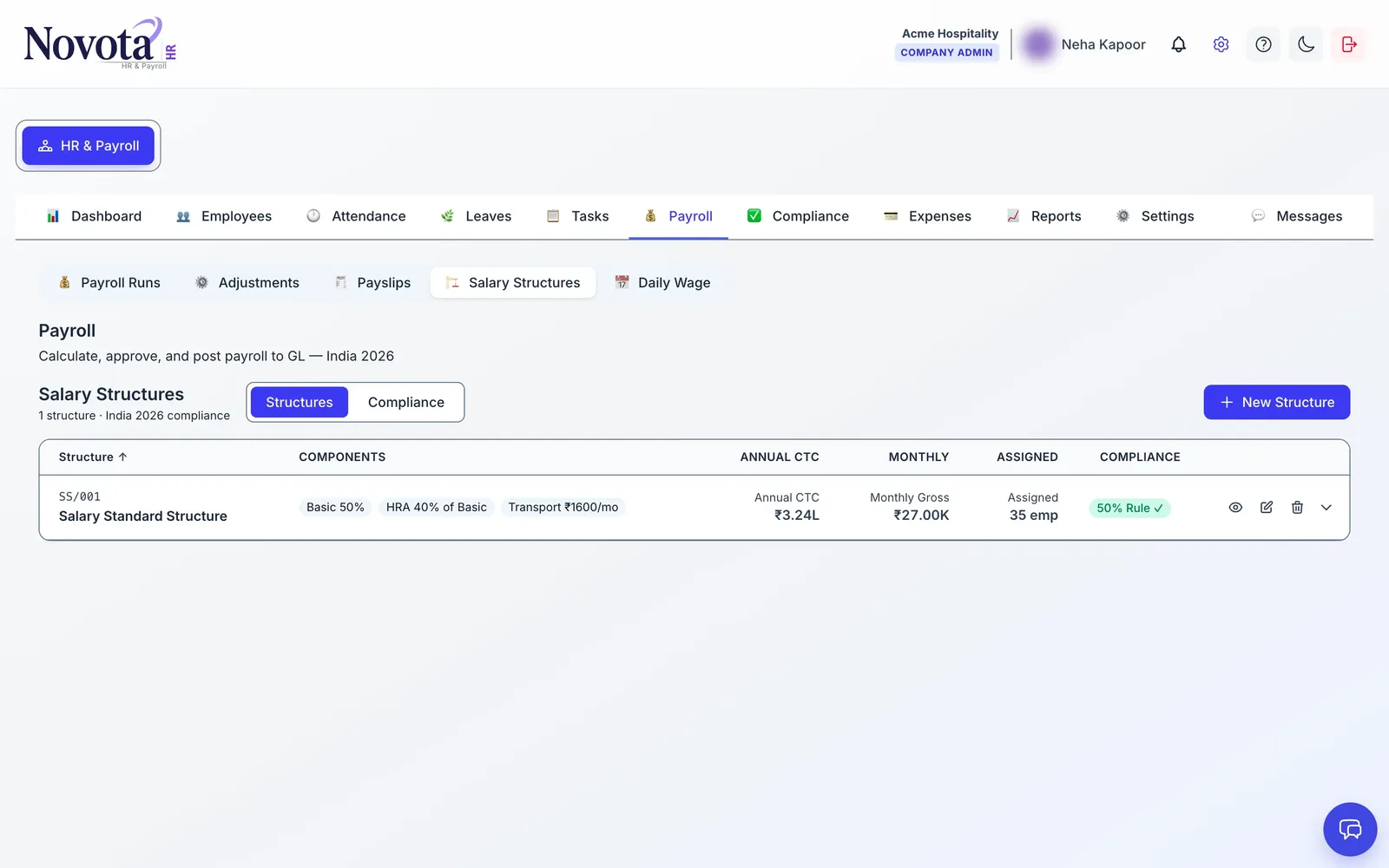 Define a structure once and assign it to everyone in that grade. The 50% rule check runs on it automatically.
PF, ESI, professional tax and TDS in plain language
These are the four statutory items that touch almost every Indian payroll. Rates and thresholds below are as of October 2026; always confirm the current notification before you file.
| Who it applies to | Contribution | Deposit by | |
|---|---|---|---|
| Provident Fund (PF) | Establishments with 20+ employees; mandatory for staff with PF wages up to ₹25,000 a month | 12% of basic + DA from the employee, 12% from the employer | 15th of the following month |
| Employees' State Insurance (ESI) | Establishments with 10+ employees (in most states) in notified areas; staff earning up to ₹21,000 a month gross (₹25,000 for persons with disability) | 0.75% from the employee, 3.25% from the employer | 15th of the following month |
| Professional tax (PT) | Employees in states that levy it, such as Maharashtra, Karnataka, West Bengal and Gujarat | State slabs, capped at ₹2,500 a year | Varies by state |
| TDS on salary | Employees whose annual salary is above the tax-free limit | Estimated annual tax, spread across the months | 7th of the following month (30 April for March) |
A few things owners often miss:
- The PF wage ceiling went up. From 17 September 2026 it is ₹25,000 a month, up from ₹15,000. Staff earning between the two are now in mandatory PF, and October 2026 is the first full month under the new limit.
- PF needs a UAN on each employee's record, and ESI needs an IP number. Collect both at joining, not at the first filing.
- TDS is an estimate. It is recalculated as the year goes on, and every employee gets Form 16 after the year ends.
- Professional tax is not national. Some states don't levy it at all, and the slabs, due dates and portals differ in those that do.
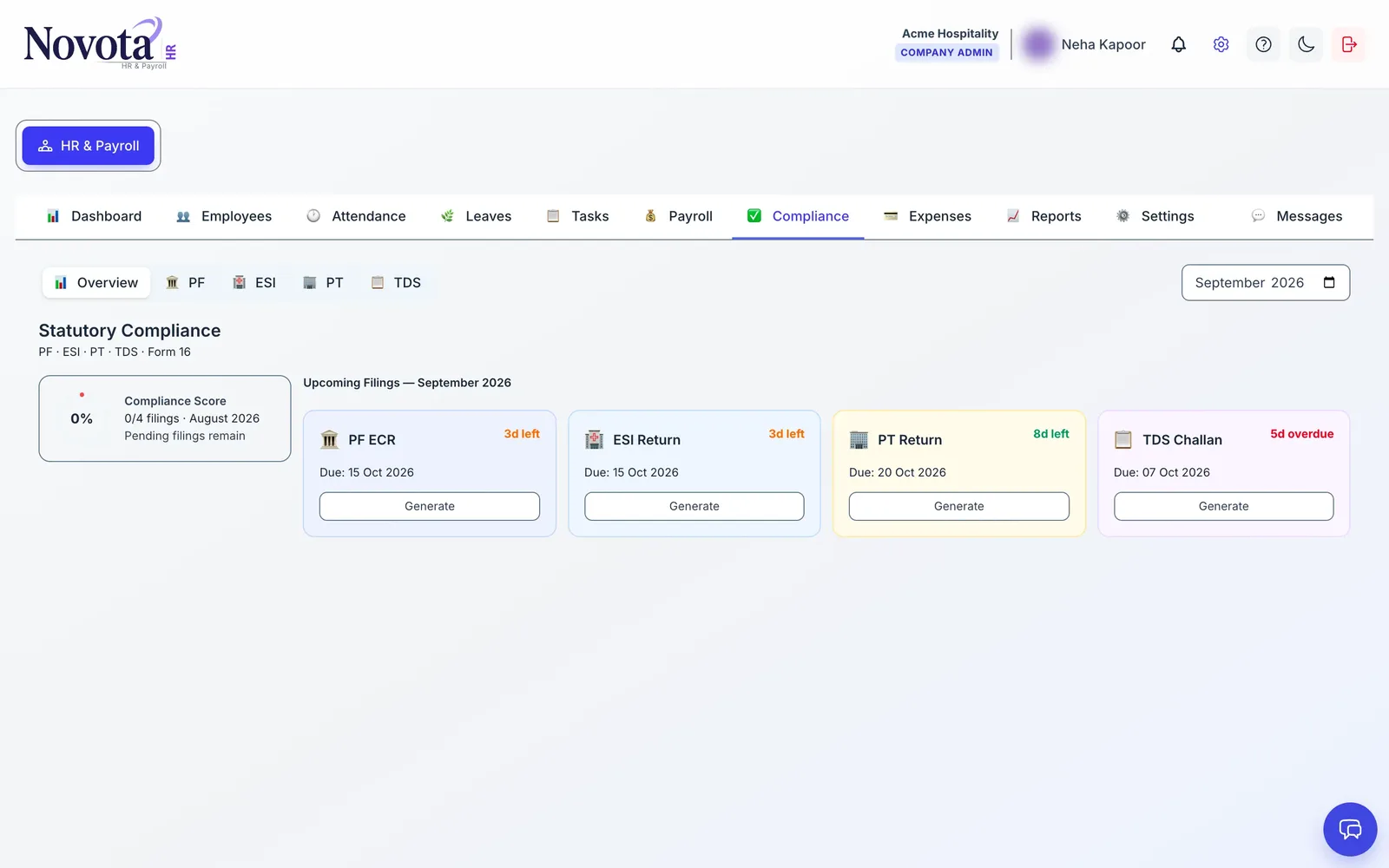 Each month's filings with their due dates, so the TDS deposit on the 7th doesn't slip past while you are waiting for the 15th.
Advances, loans and expense claims: the notebook problem
In hospitality and retail, salary advances are part of life. A cook needs ₹10,000 for a family function; a rider needs fuel money for the week. The trouble is not the advance. It is remembering to recover it, in the right instalments, from the right month's salary.
The same goes for expense claims and travel. When these live in a notebook or a WhatsApp chat:
- recoveries are forgotten or deducted twice,
- nobody can say how much is outstanding across the team,
- and the books don't match what was actually paid.
Put advances on the record instead: the employee applies on their phone, a manager approves, the amount is disbursed, and recovery is deducted from salary automatically until it is closed.
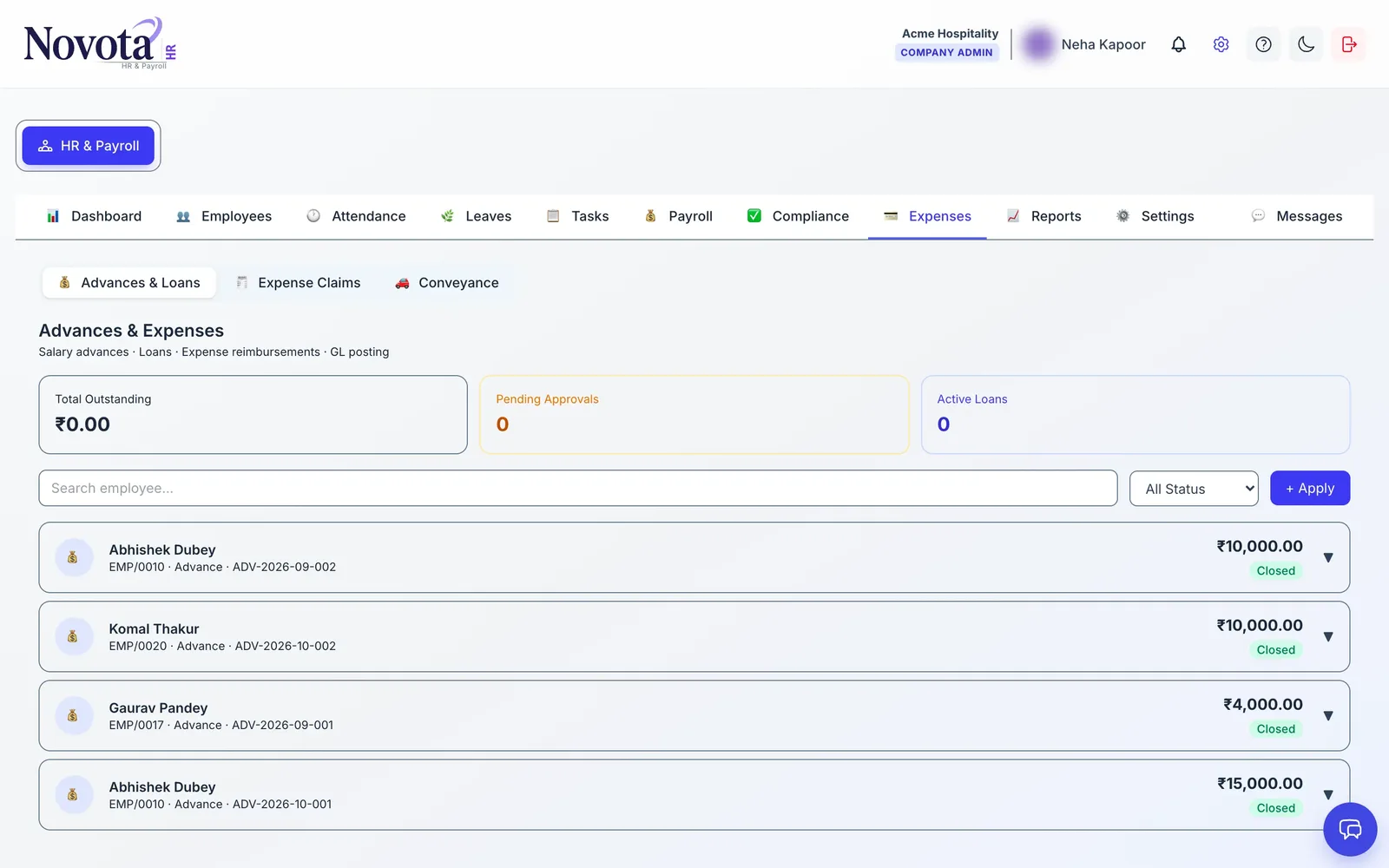 Every advance with its status, from approval to final recovery.
Signs you have outgrown the spreadsheet
Manual payroll is reasonable for a team of five. Most businesses feel the strain somewhere between 15 and 20 employees, and sooner if any of these sound familiar:
- Payroll takes you more than a day each month.
- You run shifts, or have staff across more than one outlet or site.
- Someone disputes their salary at least once a month.
- Advances and loans are tracked on paper.
- You are about to cross 10 employees (ESI) or 20 employees (PF).
- Staff keep asking for payslips, leave balances or attendance records.
- Your accountant has to re-enter salaries into the books.
How Novota HR & Payroll runs the month
Novota HR & Payroll was built for exactly these businesses: restaurants, bars, hotels and multi-outlet teams where shifts change daily and staff work from their phones. Here is how the eight steps above look in it.
1. Add your team. Upload a spreadsheet, or photograph an Aadhaar card and Novota reads the details. Each person gets one record with department, shift and salary structure.
2. Staff punch in from their phone. Every punch takes a selfie and a location. Novota checks the face against the one on record and warns when someone punches from outside the outlet. Staff who never punch in are marked absent overnight, skipping holidays and week-offs.
3. Plan shifts on a roster. Fill everyone's usual shift, paint the exceptions, split a day into two shifts or copy last week. Long days, short rest and missing days off are flagged before you publish, and each person whose shift changed gets a message.
4. Approve in a tap. Leave, advances, expense claims and overtime land with the manager. Overtime can be approved as pay or as comp-off, and balances and recoveries update by themselves.
5. Run payroll from attendance. Calculate, review and approve. PF, ESI, professional tax (with state-wise slabs) and TDS are worked out on every payslip, advances are recovered automatically, and the run is locked once approved.
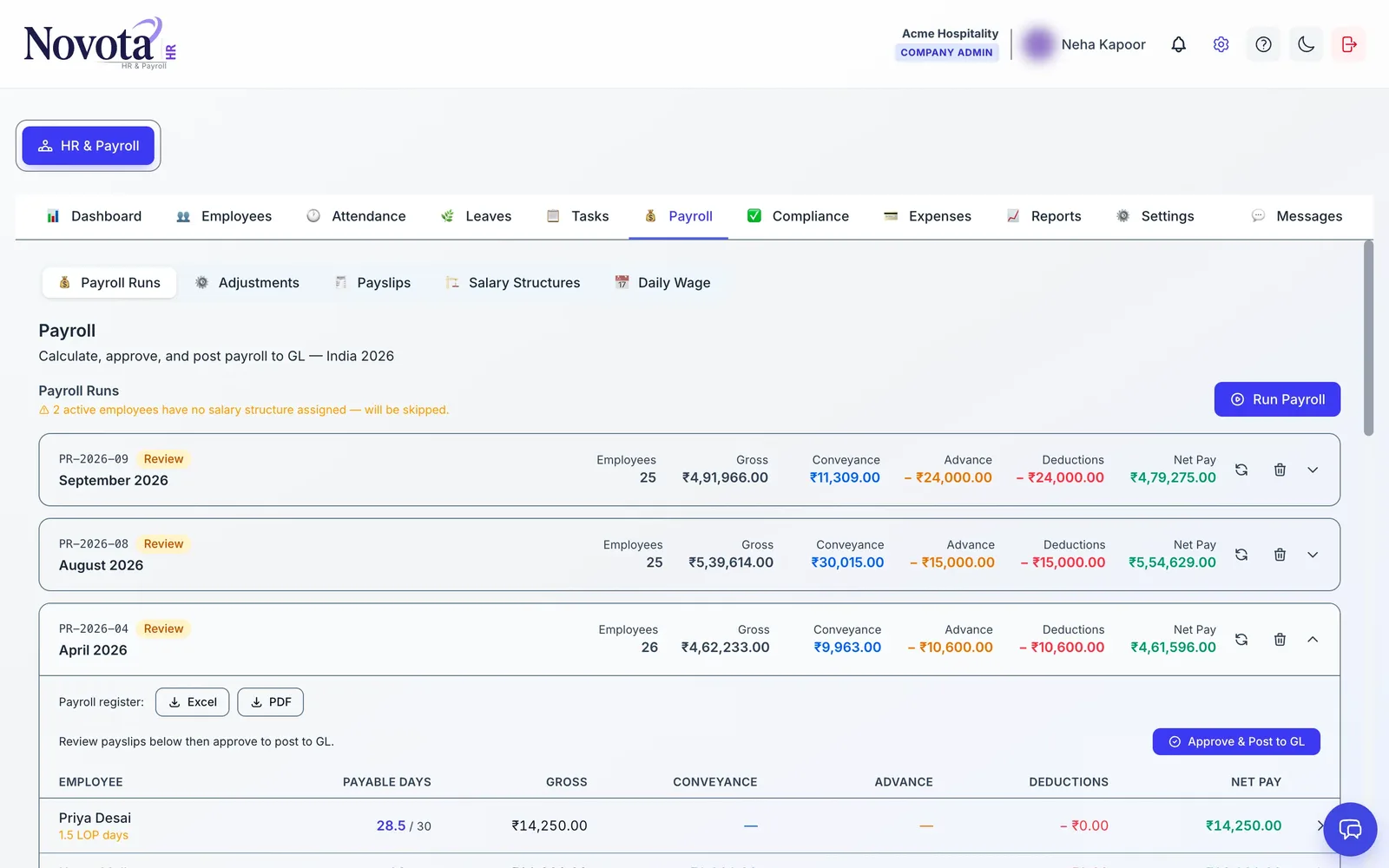 Each payroll run shows gross, recoveries, deductions and net pay, with payable days and loss-of-pay days for every employee.
6. Payslips reach every phone. Staff see their own attendance, leave, payslips and claims in the Novota HR Android app or at emp.novota.co on any phone or computer, and can share a payslip as a PDF.
7. Returns are prepared for you. PF, ESI, professional tax and TDS figures are prepared from approved payslips, and each return is tracked from generated to paid to acknowledged. Form 16 figures are ready at year end.
8. The books stay in step. When you approve payroll, a balanced journal is posted to your accounts, so the books and the payslips agree.
On top of that, team chat, tasks with photo proof and announcements people acknowledge mean the team doesn't need a separate WhatsApp group for work.
What Novota doesn't do (yet). It prepares the returns but doesn't file them: you file on the government portals. And it doesn't transfer salaries; payment still goes through your bank.
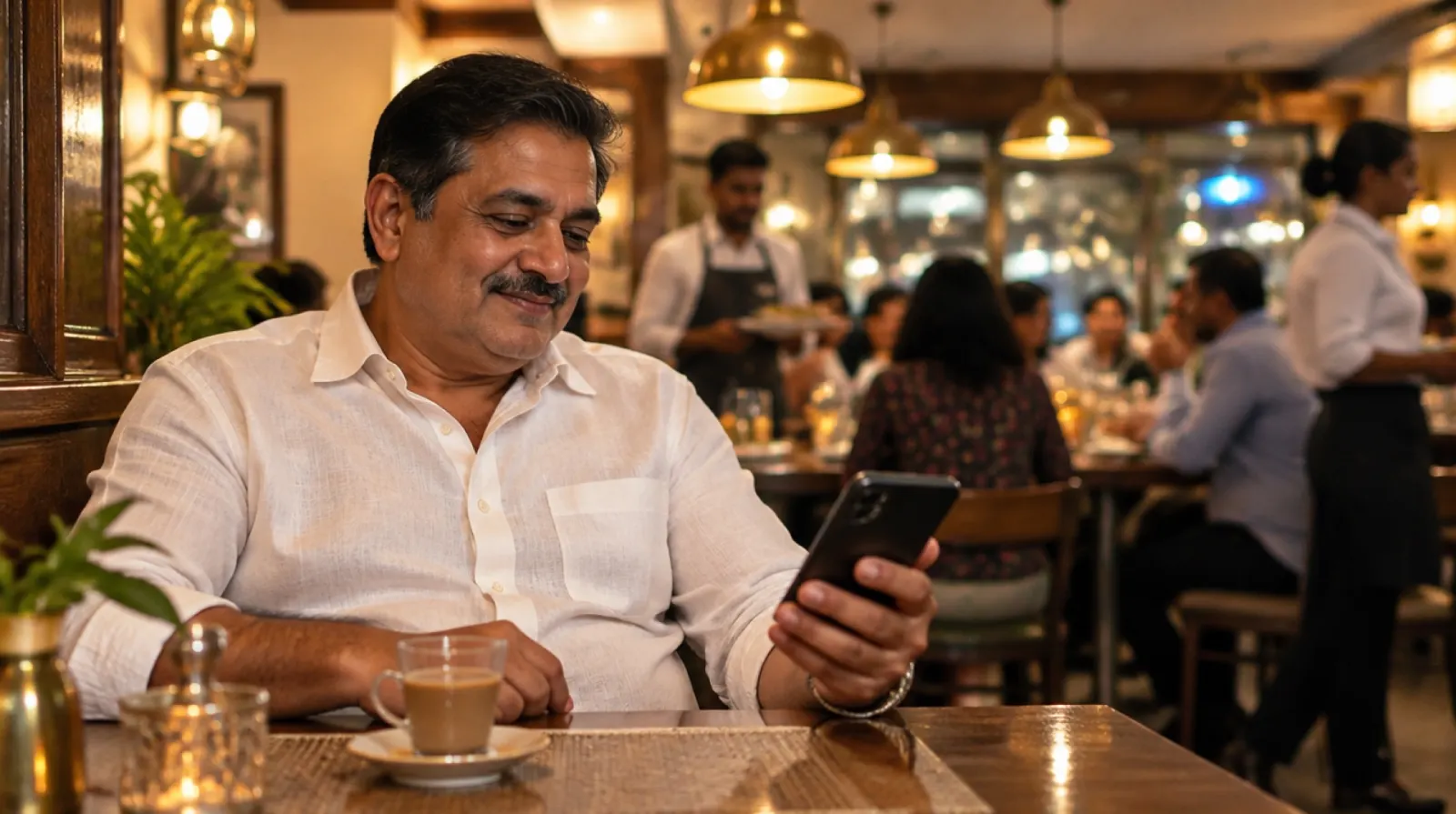 The owner's view: attendance, where people are working and payroll runs, from anywhere.
Pricing
The first month is free, with no credit card. After that it is ₹14,000 for the whole year for up to 100 employees, with everything above included. That works out to ₹1,000 a month. For teams above 100, talk to us.
Getting started: a checklist for your first payroll
You can finish a full payroll run inside the free months. Before you start, collect:
- A list of employees with joining date, department, role and outlet
- Each person's PAN, UAN (for PF), ESI IP number and bank details
- Your salary structures: basic, HRA and allowances for each grade
- Your usual shifts, week-offs and this year's holiday list
- Leave types and opening balances
- Any advances or loans still outstanding
- Your PF, ESI and professional tax registration numbers
 Once staff are set up on the app, the pre-shift briefing is about service again, not about who signed the register.
Then create your account, add the team and switch on attendance. By the end of the month, payroll is a review and an approval instead of a long night at the back-office desk.
Frequently asked questions
How does attendance affect payroll accuracy?
Salary is paid on payable days. Every missed punch, unrecorded half day, unapproved leave or forgotten week-off changes the loss-of-pay figure, and with it gross pay, PF, ESI and net pay. If attendance is captured digitally and flows straight into the payroll run, the most common cause of salary disputes disappears.
What is the difference between CTC, gross salary and net salary?
CTC is everything the employer spends on a person in a year, including the employer's PF contribution. Gross salary is what the employee earns before deductions: basic, HRA and allowances. Net salary, or take-home, is gross minus the employee's PF, ESI, professional tax and TDS.
Which statutory deductions apply to a small business in India?
PF applies once you have 20 or more employees and is mandatory for those whose PF wages are up to ₹25,000 a month (the ceiling rose from ₹15,000 on 17 September 2026). ESI applies from 10 employees in notified areas, for staff earning up to ₹21,000 a month gross. Professional tax depends on your state, and TDS applies to anyone whose salary is above the tax-free limit.
How is payroll different for shift and hourly staff?
For shift staff, late marks, overtime, week-offs and absences should be judged against the shift each person was actually rostered for, not a fixed 9-to-6 day. Daily-wage staff are paid on days worked rather than a monthly salary. Both need a roster and attendance that payroll can read directly.
When should a business move from manual payroll to software?
Usually somewhere between 15 and 20 employees, or earlier if you run shifts or more than one outlet. Other signs: payroll takes more than a day, staff dispute their salary, advances are tracked in a notebook, or you are about to cross the PF or ESI threshold.
Does Novota HR & Payroll file PF, ESI and TDS returns for me?
Novota prepares the PF, ESI, professional tax and TDS figures from approved payslips and tracks each return's due date and status. You still file on the government portals and pay salaries through your bank.