Weighing Open Bottles: How to Turn Grams into ml for a Bar Stock Count
· 3 min read
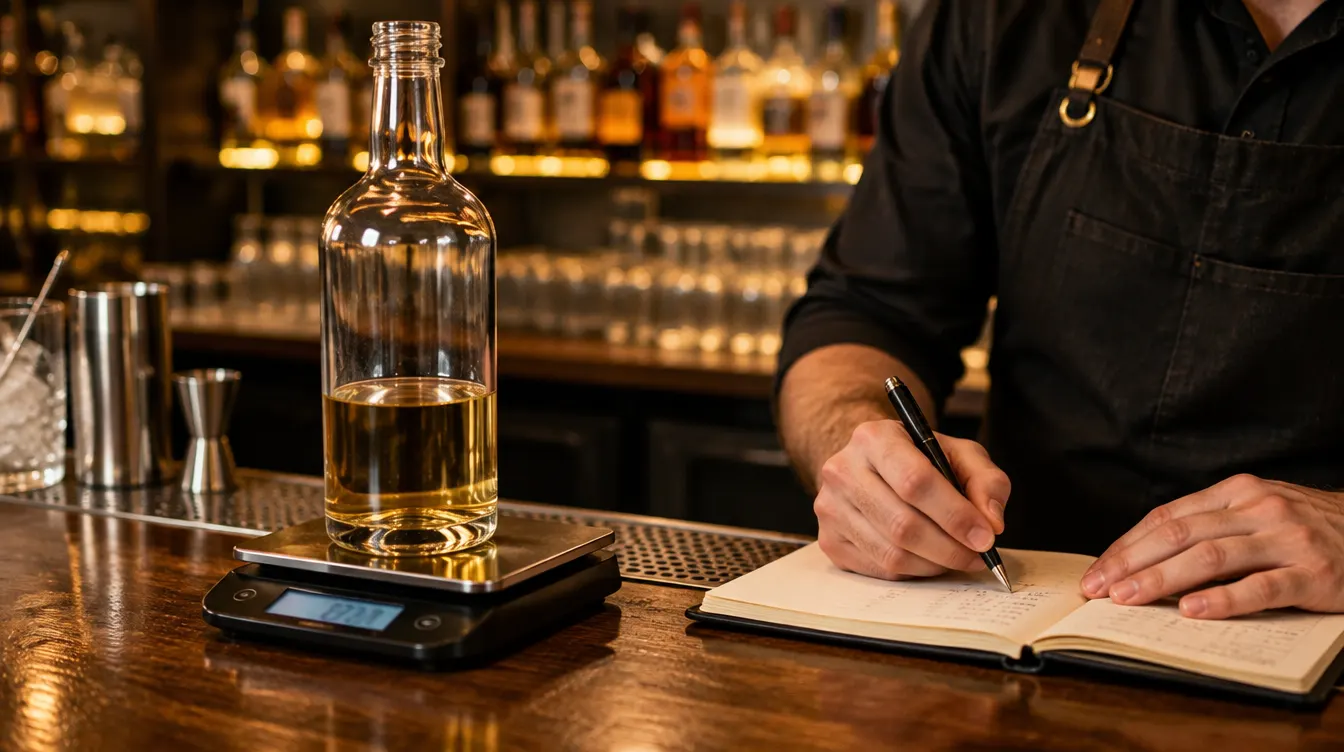
The quickest way to count an open bottle is to hold it up to the light and call it "about a third". The quickest way to lose money is to do that across a hundred bottles every week. A bottle that is really 220 ml and gets written down as 250 ml hides 30 ml, a full small peg, and the count will never show it.
Weighing fixes that. This post explains the formula, the two numbers you need per brand, and how to make it fast enough to do on a busy night. For the bigger picture of where liquor goes and how to read a variance report, see our bar stock variance guide.
The formula
ml in the bottle = (weight on the scale − empty bottle weight) ÷ density
- Weight on the scale: the open bottle, as it is, in grams.
- Empty bottle weight: the same bottle, empty and dry, in grams.
- Density: how many grams one ml of that liquid weighs.
Example
A 750 ml whisky bottle weighs 905 g on the scale. The empty bottle weighs 430 g, and the whisky's density is 0.95 g per ml.
(905 − 430) ÷ 0.95 = 475 ÷ 0.95 = 500 ml
Why density matters
Water weighs almost exactly 1 g per ml. Alcohol is lighter, so spirits weigh less than water for the same volume, and liqueurs full of sugar weigh more.
| Liquid | Typical density (g per ml) |
|---|---|
| Water | 1.00 |
| Spirits at about 40% alcohol (whisky, vodka, rum, gin) | about 0.95 |
| Cream and sweet liqueurs | about 1.05 to 1.15 |
If you skip density and treat grams as ml, every spirit reads about 5% low and every liqueur reads high. On a bar that pours thousands of pegs a month, 5% is not rounding.
Setting up your brand list
Weighing is only fast if the numbers are ready before the count starts. For each brand and size, record:
- Bottle size in ml (750, 1,000, 180 and so on).
- Empty weight in grams. Weigh one dry empty bottle, with the pourer if you count with pourers on.
- Density. Use a known figure for the brand, or work it out once: weigh a full sealed bottle, subtract the empty weight, and divide by the bottle size.
The third method is the most reliable, because it uses the actual liquid in your bar.
Density = (full bottle weight − empty bottle weight) ÷ bottle size in ml
Counting on the night
- Count in the same order every time, shelf by shelf, so nothing is skipped.
- Put each bottle on the scale, read the grams, convert, write down ml.
- Count sealed bottles separately, in whole bottles. Only open bottles need weighing.
- Do the count at the same point in the trading day each time, ideally after close.
With a paper list and a kitchen scale, a busy bar can count in under an hour. With a Bluetooth scale that sends the weight straight to the count sheet, it is faster and there is nothing to mistype.
When a scale is not practical
Some bottles do not sit well on a scale, and some bars count mid-service. Two alternatives work if they use the real bottle shape:
- Mark the level on an outline of the actual bottle, so the software accounts for the shoulders and base.
- Say the count by voice, brand and ml, with a read-back before it is saved.
Either is far better than quarters and halves.
How Novota BVR does it
Novota BVR keeps the empty weight and density for every brand. Put a bottle on a Bluetooth scale and BVR records the ml; or drag a line to the liquid level on the real bottle shape; or say the count in English, Hindi or Marathi. Every count feeds the variance report straight away. Try the free bar variance calculator to see what your last count would show.
Frequently asked questions
How do I convert a bottle's weight to ml?
Subtract the empty bottle's weight from the weight on the scale to get the weight of the liquid in grams, then divide by the liquid's density in grams per ml. For a 40% spirit the density is about 0.95, so 475 g of whisky is about 500 ml.
What is the density of whisky, vodka or rum?
Spirits at around 40% alcohol by volume weigh roughly 0.95 g per ml, a little lighter than water. Sweet liqueurs are heavier than water, often 1.05 to 1.15 g per ml, because of the sugar. Use the figure for each brand rather than one number for the bar.
Where do I get the empty bottle weight?
Weigh an empty, dry bottle of the same brand and size, with its pourer if you count with one fitted. Bottles of the same brand and size are close enough to share one figure; record it once in your brand list.
Is weighing more accurate than estimating by eye?
Yes. Bottles are not cylinders: shoulders, necks and thick bases mean a line halfway up is rarely half the liquid. A scale reads to the gram, which is about one ml.